



This research demonstrates a new way to make carbon-based battery materials much safer, longer lasting, and more powerful by fundamentally redesigning how fullerene molecules are connected. Today’s lithium-ion batteries rely mainly on graphite, which limits fast-charging speed and poses safety risks due to lithium plating. These research findings mean progress toward safer electric vehicles, longer-lasting consumer electronics, and more reliable renewable-energy storage.
The findings were published in the Journal of the American Chemical Society on December 11, 2025.
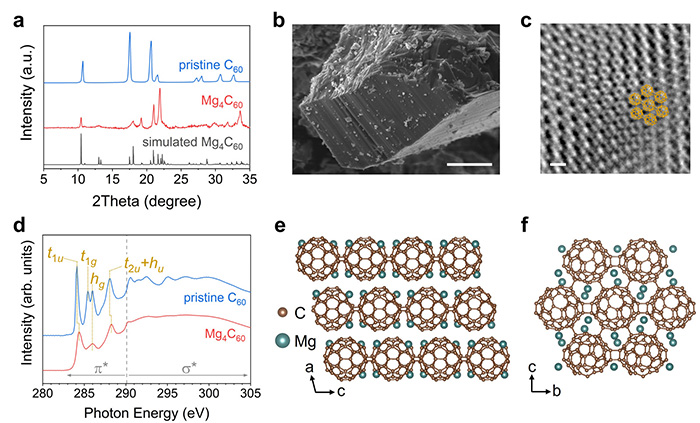
Structure of layered Mg4C60. a XRD patterns of pristine C60 and Mg4C60 powders with a simulated result for Mg4C60. b SEM image of Mg4C60 powder with a scalebar of 5 µm. c iFFT TEM image (scalebar of 1 nm) of Mg4C60 with structural illustration inset in brown. d C K-edge XAS spectra of pristine C60 and Mg4C60. Structure illustration of layered Mg4C60 observed from e b axis and f a axis. ©Shijian Wang et al.
Fullerene is a unique molecule that lends itself well to many potential applications. However, poor stability has been an issue hindering its use in batteries. A team of researchers at Tohoku University created a covalently bridged fullerene framework (Mg4C60), which shows that carbon can store lithium in a completely different and much more stable way, avoiding structural collapse and preventing the loss of active material that has long hindered fullerene anodes. This breakthrough provides a blueprint for designing next-generation battery materials that support safer fast-charging, higher energy density, and longer lifetimes.
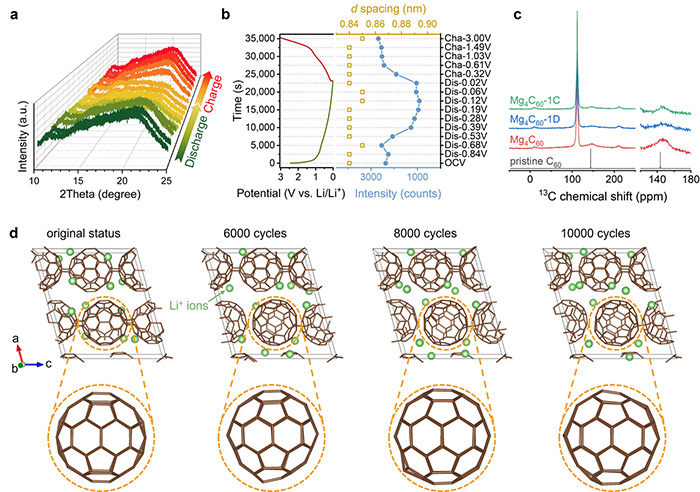
Crystal structural evolution of Mg4C60 within Li+ insertion/extraction. a In situ SXPD patterns of the Mg4C60 electrode during discharge/charge process with b corresponding galvanostatic charge/discharge profiles, d spacing variations, and intensity changes of broad peaks at ~21°. c 13C MAS-SSNMR spectra of pristine C60, Mg4C60, Mg4C60 after first discharge (Mg4C60-1D) and first full cycle (Mg4C60-1C). d AIMD simulation results of Mg4C60 with 12 inserted Li+ ions at original status and after various simulation steps. ©Shijian Wang et al.
“Our next steps are to expand this covalent-bridging strategy to a broader range of fullerene and carbon frameworks, with the goal of creating a family of stable, high-capacity anode materials suitable for fast-charging batteries,” says Distinguished Professor Hao Li (Advanced Institute for Materials Research (WPI-AIMR)).
Additional next steps will involve working with industry partners to evaluate the scalability of these materials and integrate them into practical cell formats. Understanding how to achieve real world practicality is a crucial step, one which will hopefully lead towards a future of efficient, clean-energy technologies.
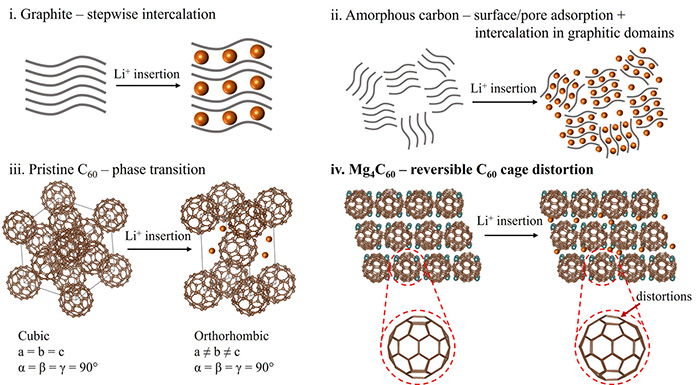
Schematic comparison of Li+ storage mechanisms in graphite, amorphous carbon, pristine C60 and Mg4C60. ©Shijian Wang et al.
| タイトル: | Covalent Bridges Enabling Layered C60 as an Exceptionally Stable Anode in Lithium-Ion Batteries |
|---|---|
| 著者: | Shijian Wang, Heng Liu, Yaojie Lei, Dongfang Li, Yameng Fan, Liang Hong, Xin Guo, Meng Wang, Zefu Huang, Yong Chen, Xu Yang, Jinqiang Zhang, Hao Li, Guoxiu Wang |
| 掲載誌: | Journal of the American Chemical Society |
| DOI: | 10.1021/jacs.5c17338 |
東北大学材料科学高等研究所(WPI-AIMR)
特任助教 Heng Liu(研究者プロフィール)
| E-mail: | heng.liu.e1@tohoku.ac.jp |
|---|
東北大学材料科学高等研究所(WPI-AIMR)
教授 Hao Li(研究者プロフィール)
| E-mail: | li.hao.b8@tohoku.ac.jp |
|---|---|
| Webstie: | Hao Li Laboratory |
東北大学材料科学高等研究所(WPI-AIMR) 広報戦略室
| Tel: | 022-217-6146 |
|---|---|
| E-mail: | aimr-outreach@grp.tohoku.ac.jp |