



The delicate butterfly served as the inspiration for a new lightweight lattice structure that also boasts enhanced mechanical strength, impact resistance, and energy absorption capability through advanced structural design. A collaborative research team from Tohoku University and the Wuhan University of Technology developed this strong yet light-as-a-butterfly material with the hopes of one day using it for airplanes or earthquake-resistant infrastructure.
Inspired by the vein geometry of butterfly wings that evenly distribute stress, the researchers designed a butterfly-shaped body-centered cubic lattice architecture. Rather than relying on changes in the base material itself (which can be an intensive undertaking), the study demonstrates how structural topology can fundamentally determine stiffness, strength, deformation behavior, and failure resistance.
Mechanical testing and finite-element simulations revealed that the new structure significantly outperforms conventional lattice designs under both quasi-static compression and dynamic impact loading. In particular, the newly designed lattice exhibited markedly higher elastic modulus, plateau stress, and energy absorption performance. Under impact conditions, the structure effectively redistributed stress through an X-shaped deformation pathway (like a butterfly spreading its wings), suppressing localized collapse and delaying catastrophic failure.
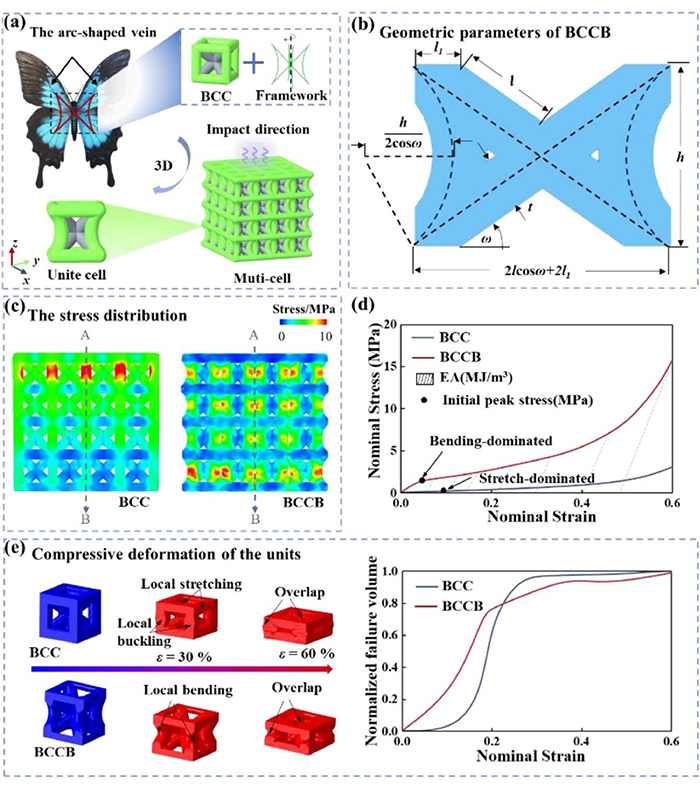
Design methods of the butterfly lattice structure. ©Eric Jianfeng Cheng et al.
“This structural mechanism is particularly remarkable, since most lightweight lattice materials aren’t able to withstand forces like local buckling or shock,” remarks Eric Jianfeng Chen of Tohoku University. “In contrast, our design shows a much greater resistance to sudden mechanical loading.”
The findings provide a new design strategy for lightweight protective structures, impact-resistant metamaterials, and advanced mechanical components for potential transportation and aerospace applications. In Japan, where earthquake resilience is of major societal importance, such lightweight energy-absorbing structural concepts could be highly useful for future protective engineering systems.
The findings were published in the International Journal of Mechanical Sciences on January 27, 2026. This publication was made open access through support from Tohoku University’s FY2025 Open Access Promotion Support Program.
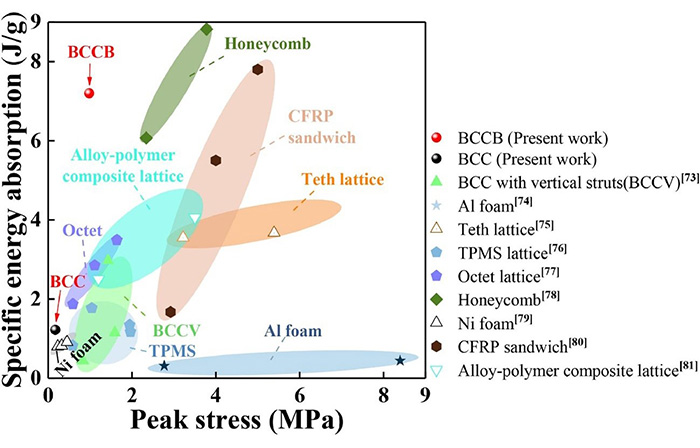
Comparison of the specific energy absorption versus peak stress with other most advanced and composite structures. ©Eric Jianfeng Cheng et al.
| タイトル: | Anisotropic butterfly-inspired lattice structures for enhanced impact resistance |
|---|---|
| 著者: | Jing Wei, Xiao Wang, Qinqin Wei, Guoqiang Luo, Eric Jianfeng Cheng, Qiang Shen |
| 掲載誌: | International Journal of Mechanical Sciences |
| DOI: | 10.1016/j.ijmecsci.2026.111298 |
東北大学材料科学高等研究所
准教授 程建鋒(研究者プロフィール)
| Tel: | 022-217-5990 |
|---|---|
| E-mail: | ericonium@tohoku.ac.jp |
東北大学材料科学高等研究所(WPI-AIMR) 広報戦略室
| Tel: | 022-217-6146 |
|---|---|
| E-mail: | aimr-outreach@grp.tohoku.ac.jp |