


Electron spin is a quantum property that makes electrons behave like tiny magnets. It can influence how electrons interact with each other and how chemical reactions take place.
But what does this have to do with producing fertilizers, making cleaner fuels, or improving energy technologies? What connects all these processes is the use of catalysts, materials that help chemical reactions happen faster and more efficiently. By controlling electron spin, scientists may be able to improve how these catalysts work, opening up new possibilities for more efficient chemical processes.
This has led scientists to ask an intriguing question: What if better catalysts were just a spin away? In a new article published in Accounts of Materials Research, researchers explore this possibility, showing how to achieve this.
Catalysts are usually improved by changing their composition, atomic structure, or surrounding environment. Researchers have also explored the use of magnetic fields to influence catalytic reactions. While some studies have shown promising results, it remains unclear how exactly magnetic fields affect catalyst performance. Their effects may come from changes in temperature or the movement of substances during a reaction, rather than from electron spin itself. Understanding what causes which improvement is therefore an important step toward making better use of electron spin in catalyst design.
This is where a new approach called “explicit spin regulation” comes in. It aims to establish a clearer link between electron spin and catalyst performance. The idea is to control spin-related properties in the parts of a catalyst where chemical reactions take place and examine how these changes affect the reaction.
Scientists can do this in two ways: by adding materials that influence electron spin or by using magnetic fields and magnetic components during a reaction. Previous studies of cobalt catalysts used to produce ammonia suggest that certain additives may make it easier to break the strong bonds holding nitrogen molecules together.
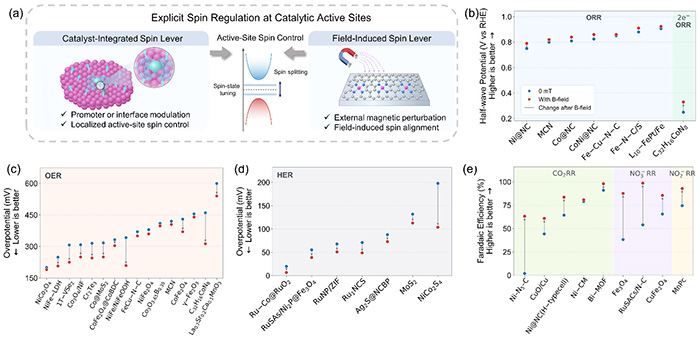
Two ways to change electron spin at reaction sites, alongside examples of how magnetic fields can affect catalyst performance. ©Hao Li et al.
To better understand this area of research, the authors examined 249 electrocatalysis studies published between 2022 and 2026. They looked at how scientists use magnetic effects to improve catalysts and how they explain the results. In 53% of these studies, changes in electron spin or other electronic properties were suggested as the main reason for improved performance.
However, more evidence is needed to confirm whether these changes are actually responsible for the improvements. The authors therefore emphasize the importance of understanding exactly how electron spin affects chemical reactions. This involves identifying what changes in the catalyst, how electron spin responds, and how these changes influence individual steps in a reaction.
“Electron spin offers us a new way to think about how catalysts work,” says Hao Li, a Distinguished Professor at Tohoku University’s Advanced Institute for Materials Research (WPI-AIMR). “We want to understand how it influences their performance and why it matters in different chemical reactions. By learning when and why spin matters, we hope to use this knowledge to develop more efficient catalysts.”
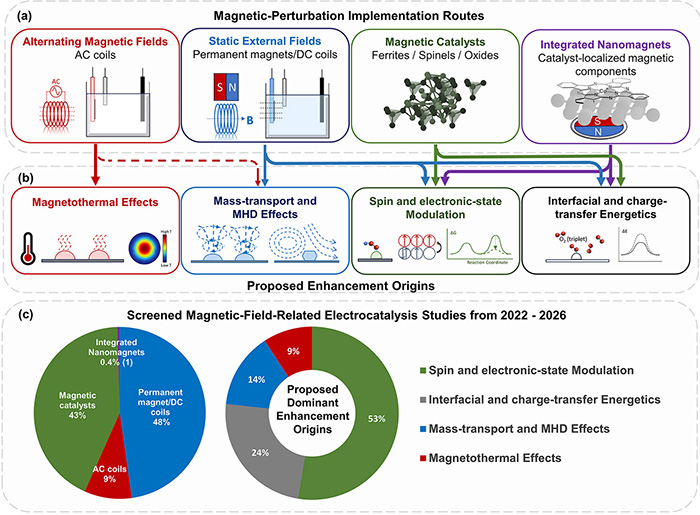
An analysis of 249 studies showing how magnetic effects are introduced and what may explain changes in catalytic performance. ©Hao Li et al.
The next step is to use this knowledge to design better catalysts. Previous studies have already used computer calculations to identify 40 promising catalyst candidates containing pairs of metal atoms for reactions involving oxygen. This approach could help scientists identify promising materials before testing them in the laboratory.
Looking ahead, the authors suggest combining knowledge of electron spin with data and artificial intelligence to help discover new materials and improve catalyst design.
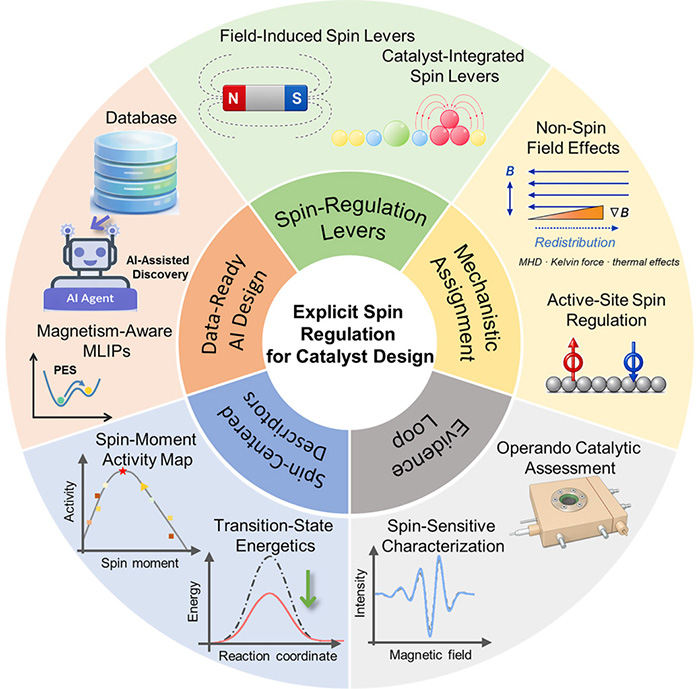
A roadmap for connecting electron spin to chemical reactions and using data and AI to guide catalyst design. ©Hao Li et al.
| Title: | Explicit Spin Regulation as an Emerging Design Paradigm in Heterogeneous Catalysis |
|---|---|
| Authors: | Tingyu Lu, Yuan Huang, Ang Cao, Li Wei, Hao Li |
| Journal: | Accounts of Materials Research |
| DOI: | 10.1021/accountsmr.6c00167 |
Hao Li (Profile)
Advanced Institute for Materials Research (WPI-AIMR), Tohoku University
| E-mail: | li.hao.b8@tohoku.ac.jp |
|---|---|
| Website: | Hao Li Laboratory |