



There is a near infinite number of material candidates out there – and simply not enough time to hunker down in the lab and test them all. Thankfully, researchers have a variety of tools (such as AI) at their disposal to streamline what would otherwise be a time-consuming process of trial-and-error. To create an efficient materials design workflow, a team of researchers at Tohoku University is suggesting not just one tool – but a whole toolbox that works together as a cohesive kit.
This comprehensive system is called a “digital materials ecosystem” because it integrates multiple processes together instead of treating them as disconnected steps. For example, the ecosystem is capable of not only predicting how certain materials will react, but also orchestrating multi-step scientific workflows including searching for evidence, screening candidates, and deciding what to test next.
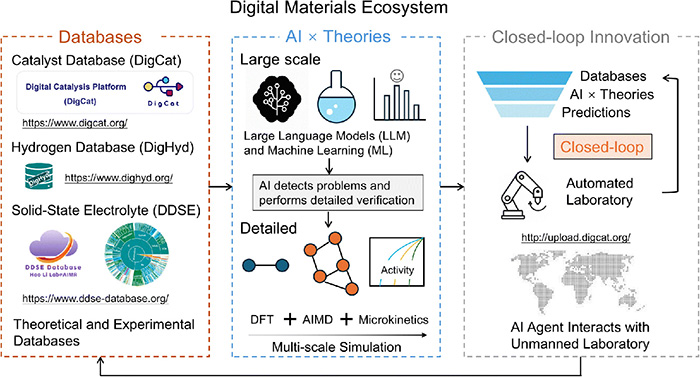
Schematic illustration of the concept of the digital materials ecosystem. This concept consists of databases (left frame), AI and theoretical frameworks (middle frame), and closed-loop innovation based upon modern experimental techniques (right frame). ©Di Zhang et al.
“The ecosystem frames materials discovery as a closed-loop, self-improving system,” explains Distinguished Professor Hao Li (Advanced Institute for Materials Research (WPI-AIMR)). “It takes sources from reliable databases, does a ‘sanity check’ of sorts against known physics or theory frameworks, and draws from AI to make sophisticated recommendations.”
This ecosystem means that we can quickly sort through multiple terabytes worth of existing research literature to set up future studies for success. The more it is used, the more the system can iteratively learn what works, why it works, and what to try next—moving materials science from empirical trial-and-error towards a more systematic, predictive, and scalable discipline.
“The ecosystem can be used by anyone in materials science – we designed it to span a wide range of material classes from solid-state batteries to catalysts,” remarks first author Di Zhang (WPI-AIMR).
The model is expected to improve as more data is added to the databases. The team is excited to continually work on this digital materials ecosystem so it can process more complex, nuanced information and learn to think more like human scientists when providing research guidelines.
In recognition of their achievements in AI for materials science, Chemical Science invited Hao Li to publish this paper highlighting their original concept of a Digital Materials Ecosystem (published February 23, 2026).
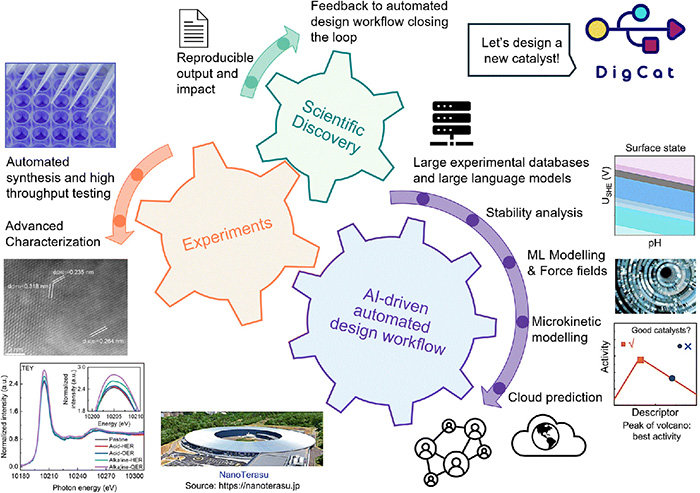
Inclusion of a thorough AI-driven automated design workflow towards accelerating scientific discoveries in a closed-loop framework (reference place holder for cloud synthesis). The integrated design framework connects high-throughput experiments, AI-driven automated workflows, and scientific insights to accelerate catalyst development. By coupling robotic experimentation and advanced characterization with machine learning-guided screening, descriptor analysis, and mechanistic understanding, the DigMat platform enables continuous feedback between data, models, and experiments. ©Di Zhang et al.
| タイトル: | Digital materials ecosystem: from databases to AI agents for autonomous discovery |
|---|---|
| 著者: | Di Zhang, Xue Jia, Yuhang Wang, Heng Liu, Qian Wang, Seong-Hoon Jang, Daksh Shah, Songbo Ye, Hung Ba Tran and Hao Li |
| 掲載誌: | Chemical Science |
| DOI: | 10.1039/D5SC09229A |
東北大学材料科学高等研究所(WPI-AIMR)
助教 Di Zhang(研究者プロフィール)
| E-mail: | di.zhang.a8@tohoku.ac.jp |
|---|
東北大学材料科学高等研究所(WPI-AIMR)
教授 Hao Li(研究者プロフィール)
| E-mail: | li.hao.b8@tohoku.ac.jp |
|---|---|
| Webstie: | Hao Li Laboratory |
東北大学材料科学高等研究所(WPI-AIMR) 広報戦略室
| Tel: | 022-217-6146 |
|---|---|
| E-mail: | aimr-outreach@grp.tohoku.ac.jp |