


From dyes to pharmaceuticals to emulsifiers – ethylamine (EA) is a versatile component used in many industries. The downside of EA is that its production is terribly complicated and energy intensive. However, it is not a simple task to simplify EA production in a way that can also be scaled up to industrial levels.
Researchers at Tohoku University’s WPI-AIMR may have found an answer to this problem. Rare earth Eu atoms were modified on Cu2O nanoneedles to produce a catalyst (Eu-Cu2O) that can increase the efficiency of the chemical reaction that produces EA. This means it no longer consumes such a large amount of energy to produce. Remarkably, the reaction achieves an EA Faradaic efficiency of 98.1% and can operate continuously for up to 420 hours. To date, this finding holds the record for the longest reported activity whilst maintaining stability – all under industrial conditions.
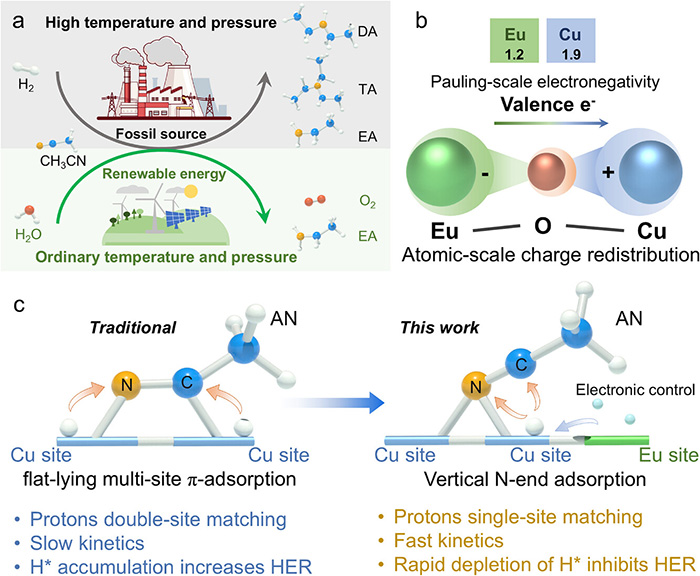
(a) Comparison of conventional thermal, catalytic, and electrocatalytic pathways for AN hydrogenation. The thermal route often suffers from low selectivity and undesirable byproducts, while the electrochemical approach enables greener and highly selective EA synthesis. (b) Electronic structure modulation of metal sites induced by Eu doping, demonstrating its potential to regulate the adsorption configuration of key reaction intermediates. (c) Proposed mechanism of Eu-mediated transition of the AN intermediate from flat π-adsorption to vertical N-end vertical adsorption, facilitating efficient protonation and suppressing competing hydrogen evolution. ©Han Du et al.
This research introduces a unique rare‐earth atom–mediated strategy to achieve industrial-scale electrosynthesis of ethylamine under mild conditions. By precisely tuning the electronic structure of Cu2O through atomic europium incorporation, the method enables a unique switch in acetonitrile adsorption configuration that overcomes long-standing challenges of selectivity loss and instability at ampere-level currents.
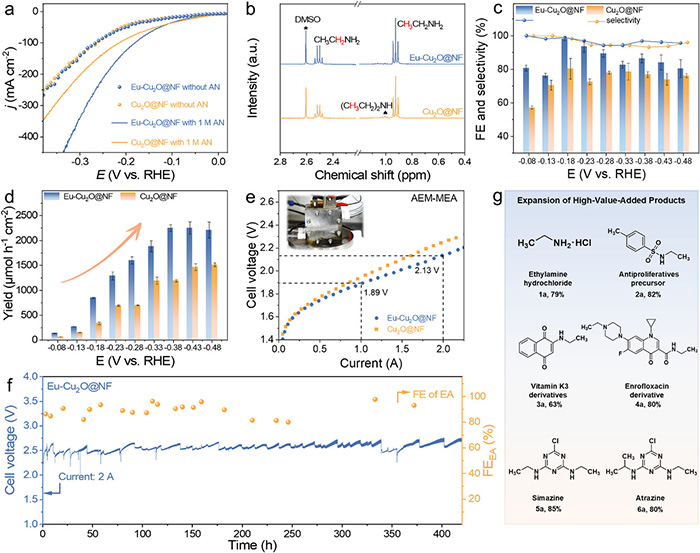
(a) LSV curves at a scan rate of 10 mV s−1 in the electrolyte of 1.0 m KOH and 1.0 m KOH containing 8wt.% AN; (b) 1H NMR of products from Eu-Cu2O@NF and Cu2O@NF; (c) FE, selectivity and (d) EA yield rate of Eu-Cu2O@NF and Cu2O@NF under different bias potential; (e) Polarization curve of Eu-Cu2O@NF and Cu2O@NF in AEM reactor; (f) the chronopotentiometry test and corresponding FE results; (g) Expansion of high-value-added products by EA produced by AN-ECH: (1a) Ethylamine hydrochloride; (2a) Antiproliferatives precursor; (3a) Vitamin K3 derivatives; (4a) Enrofloxacin derivative; (5a) Simazine; (6a) Atrazine, the yield is indicated after the label number. ©Han Du et al.
The importance of these findings extends beyond the laboratory, as the developed catalyst supports continuous, energy-efficient production of EA—an essential precursor in pharmaceuticals, agrochemicals, and more—using electricity and water instead of fossil-derived hydrogen. This advancement represents a vital step toward sustainable, electrified chemical manufacturing for a low-carbon future.
The findings were published in Advanced Materials on January 20, 2026.
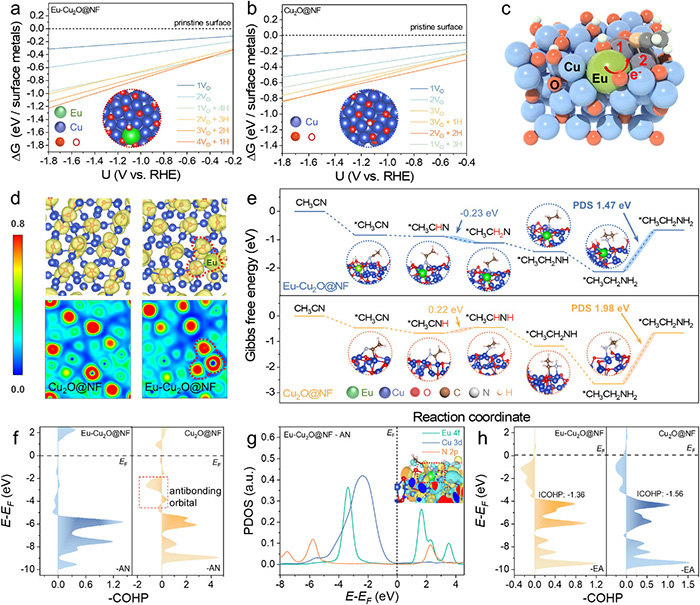
Theoretical insights into AN-ECH: Surface Pourbaix diagrams of (a) Eu-Cu2O@NF and (b) Cu2O@NF; (c) Bader charge of the Eu-Cu2O@NF surface; (d) ELF maps of Eu-Cu2O@NF and Cu2O@NF; (e) Gibbs free energy diagrams and corresponding geometric structures on the Eu-Cu2O@NF and Cu2O@NF; (f) COHP maps of Cu-N bonds of AN absorbed in Eu-Cu2O@NF and Cu2O@NF; (g) PDOS maps of AN absorbed in Eu-Cu2O@NF, and the Figure inset shows the band-decomposed charge density, with blue and yellow representing wave functions of two different phases; (h) COHP maps of Cu-N bonds of EA absorbed in Eu-Cu2O@NF and Cu2O@NF. ©Han Du et al.
| タイトル: | Atomic Eu-Mediated Acetonitrile Adsorption Configuration Switch Drives Long-Term and Ampere-Level Electrosynthesis of Ethylamine in AEM Electrolyzer |
|---|---|
| 著者: | Han Du, Xuan Wang, Meng Li, Ransheng Lv, Caikang Wang, Wentao Xue, Liangcheng Li, Dongmei Sun, Yawen Tang, Hao Li, Gengtao Fu |
| 掲載誌: | Advanced Materials |
| DOI: | 10.1002/adma.202521105 |
東北大学材料科学高等研究所(WPI-AIMR)
教授 Hao Li(研究者プロフィール)
| E-mail: | li.hao.b8@tohoku.ac.jp |
|---|---|
| Webstie: | Hao Li Laboratory |
東北大学材料科学高等研究所(WPI-AIMR) 広報戦略室
| Tel: | 022-217-6146 |
|---|---|
| E-mail: | aimr-outreach@grp.tohoku.ac.jp |