


A new study sheds light on how hydrogen can be stored and released more effectively using magnesium hydride (MgH2), offering fresh direction for clean energy technologies.
Hydrogen is widely seen as a flexible energy carrier, but storing it in a compact and practical way remains a key challenge. Materials must not only hold hydrogen safely, but also release it under conditions suitable for everyday use.
MgH2 has long attracted attention because it can store a large amount of hydrogen using widely available elements. However, releasing that hydrogen typically requires high temperatures, limiting its use in practical systems.
To overcome this the researchers focused on a phenomenon known as the “burst effect (also called, the dam-break effect).” In this process, the first step of hydrogen release from the material’s surface is the most difficult, while the remaining hydrogen is released more easily once that initial barrier is overcome.
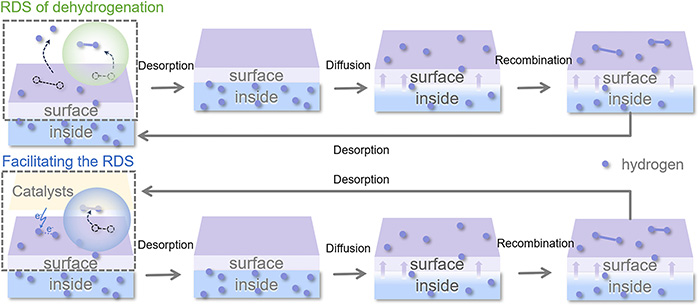
Rate-determining step in MgH2 dehydrogenation and its surface catalytic promotion ©Hao Li et al.
By targeting this critical first step, the researchers found that the catalysts can reshape the release process. Small changes at the surface can influence how quickly and efficiently hydrogen becomes available.
The study also highlights the growing role of computational tools in materials research. Techniques such as simulations and data-driven models allow scientists to explore new designs more efficiently and understand how microscopic changes affect real-world performance.
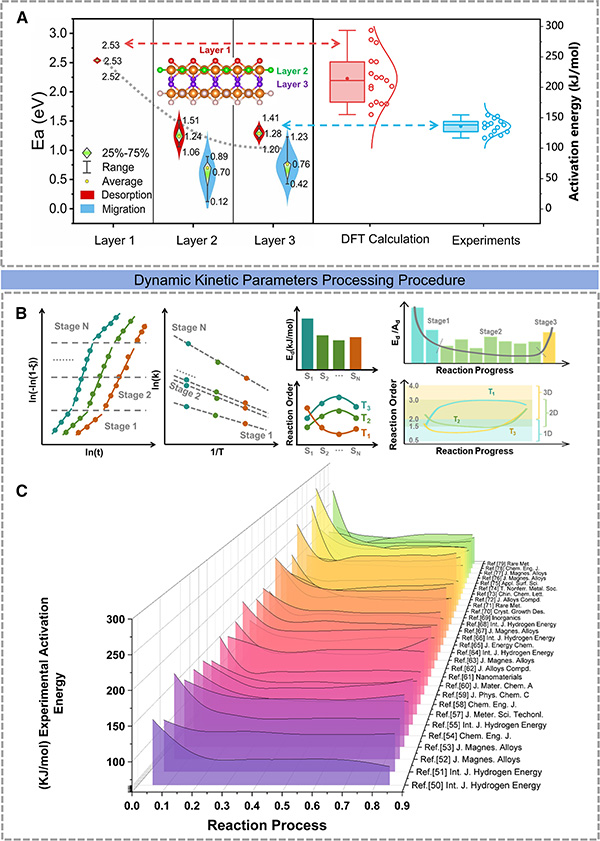
Density functional theory calculations and data-driven methodology for identifying the “burst effect” in MgH2 dehydrogenation. Reprinted with permission from Cai et al. 18 Copyright 2025 Elsevier. ©Hao Li et al.
“This combined approach links fundamental insights with practical design strategies,” said Hao Li, Distinguished Professor at Tohoku University’s Advanced Institute for Materials Research (WPI-AIMR). “It points toward a more deliberate way of developing hydrogen storage materials, rather than relying on incremental improvements.”
The work builds on Li’s earlier discovery of the burst effect in MgH2.
Looking ahead, the team plans to further integrate artificial intelligence into catalyst development. This direction could help refine material design and support the broader adoption of hydrogen-based energy systems.
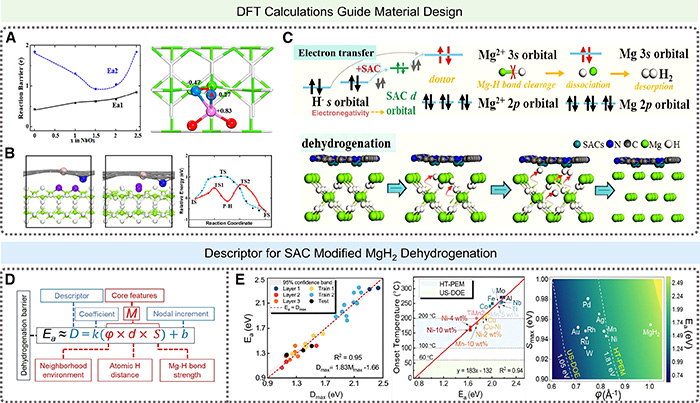
Theory-guided design strategies for materials and catalysts. Reprinted with permission from Li et al. 20 Copyright 2024 Wiley-VCH. ©Hao Li et al.
| タイトル: | Catalytic strategies and mechanisms for enhancing MgH2 solid-state hydrogen storage |
|---|---|
| 著者: | Zhengyang Gao, Xiaojin Yang, Zelong Zhuang, Yizhou Zhang, Jianghao Cai, Yanxin Li, Wenfeng Fu, Hao Li and Weijie Yang |
| 掲載誌: | Chem Catalysis |
| DOI: | 10.1016/j.checat.2026.101692 |
東北大学材料科学高等研究所(WPI-AIMR)
教授 Hao Li(研究者プロフィール)
| E-mail: | li.hao.b8@tohoku.ac.jp |
|---|---|
| Webstie: | Hao Li Laboratory |
東北大学材料科学高等研究所(WPI-AIMR) 広報戦略室
| Tel: | 022-217-6146 |
|---|---|
| E-mail: | aimr-outreach@grp.tohoku.ac.jp |