



Recent progress in advanced energy manufacturing has opened a new path for lithium battery design. A joint research team led by Associate Professor Eric Jianfeng Cheng of Tohoku University has published a major review in Materials Science and Engineering: R: Reports on March 30, 2026, that highlights the potential, the pitfalls, and different perspectives of 3D printing’s role in manufacturing lithium batteries. The article provides a systematic roadmap for how 3D printing may redefine next-generation lithium batteries.
The review shows that 3D printing can move battery manufacturing beyond the geometric limits of conventional coating-based production. Instead of relying on flat, stacked shapes, 3D printing enables precise control over three-dimensional structures. This topology-driven design can shorten ion-transport pathways, improve electron conduction, reduce local stress concentration during cycling, and enhance mechanical robustness. In this sense, 3D printing is not simply a new processing method, but a way to redesign how electrochemical performance is built into battery structure itself.
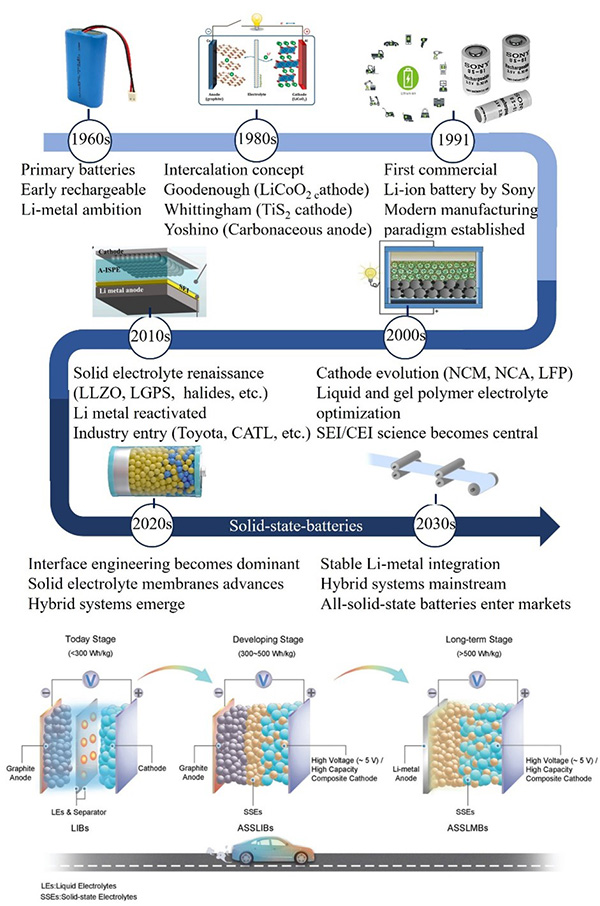
Overview of the historical development of lithium batteries. ©Eric Jianfeng Cheng et al.
The paper places particular emphasis on all-solid-state lithium batteries, where both energy density and interface quality are critical. For these systems, the challenge is not merely to print battery components, but to fabricate thin, structurally precise solid-electrolyte architectures while maintaining low interfacial resistance and reliable ionic transport. The review critically analyzes the key scientific bottlenecks involved, especially the trade-off between high ceramic filler content, ink rheology, sub-100-micrometer structural fidelity, and interfacial integrity in composite solid electrolytes.
“We believe the next stage of progress will depend on integrating artificial intelligence (AI) with 3D printing,” says Siraprapha Deebansok (Tohoku University). “The guidance of data-driven AI can help us move away from trial-and-error, and towards intelligent manufacturability.”
This research provides one of the most comprehensive roadmaps to date for applying 3D printing technologies to lithium battery manufacturing. The research team thoroughly examines how the precise control of 3D printing could improve a battery’s energy density, safety, and stability. This framework may accelerate the design of advanced batteries for electric vehicles, flexible electronics, and grid-scale energy storage.
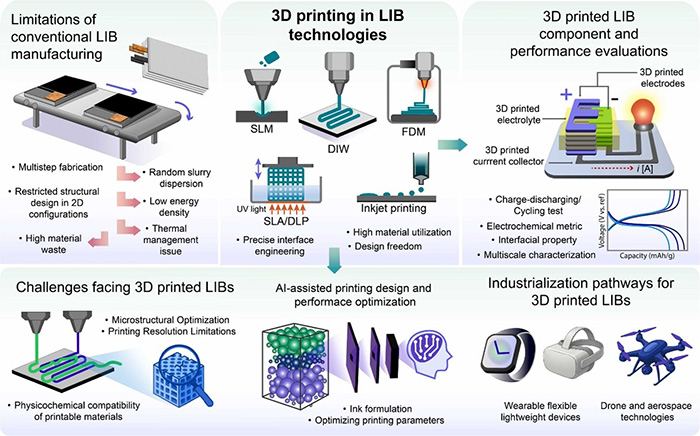
Schematic overview of the design, technologies, challenges, and industrial pathways of 3D-printed lithium batteries. ©Eric Jianfeng Cheng et al.
| タイトル: | 3D printing in lithium battery manufacturing: Opportunities, challenges, and perspectives |
|---|---|
| 著者: | Jing Wei, Sirapraph Deebansok, Xin He, Qian Wang, Tanant Waritanan, Zijian Geng, Ying Li, Manoj Gautam, Guoqiang Luo, Yizhou Zhang, Hongze Wang, Xuning Feng, Hirotoshi Yamada, Hyoung Seop Kim, Hidemi Kato, Shin-ichi Orimo, Kiyoshi Kanamura, Venkataraman Thangadurai, Eric Jianfeng Cheng |
| 掲載誌: | Materials Science and Engineering: R: Reports |
| DOI: | 10.1016/j.mser.2026.101211 |
東北大学材料科学高等研究所
准教授 程建鋒(研究者プロフィール)
| Tel: | 022-217-5990 |
|---|---|
| E-mail: | ericonium@tohoku.ac.jp |
東北大学材料科学高等研究所
助教 Siraprapha Deebansok(研究者プロフィール)
| E-mail: | deebansok.siraprapha.c4@tohoku.ac.jp |
|---|
東北大学材料科学高等研究所(WPI-AIMR) 広報戦略室
| Tel: | 022-217-6146 |
|---|---|
| E-mail: | aimr-outreach@grp.tohoku.ac.jp |