



Hydrogen is expected to play a central role in future clean energy systems but storing it efficiently and safely remains one of the biggest challenges to its widespread adoption. Solid-state hydrogen storage, in which hydrogen is absorbed into metals, is considered a promising alternative to high-pressure tanks. However, many hydrogen-storage alloys face a fundamental trade-off between storage capacity and material stability.
In a new study published in Chemistry of Materials, a research team led by Distinguished Professor Hao Li of Tohoku University’s WPI-AIMR has uncovered a previously underappreciated factor that governs this trade-off: magnetism. The researchers show that by controlling the magnetic properties of hydrogen-storage alloys, it is possible to design materials that are both thermodynamically stable and capable of storing large amounts of hydrogen.
“Magnetism is usually not considered a central factor in hydrogen storage materials,” says Li. “Our results show that magnetic interactions can decisively determine whether an alloy is stable or unstable. By suppressing magnetism, we can significantly expand the range of compositions that are suitable for hydrogen storage.”
The team focused on AB3-type intermetallic alloys, a class of materials known for their fast hydrogen absorption and good reversibility. Using advanced first-principles calculations combined with Monte Carlo simulations, the researchers systematically investigated alloys composed of calcium, yttrium, and magnesium at the A-site, and cobalt or nickel at the B-site.
Their analysis revealed a direct and robust link between magnetic strength and alloy stability. In cobalt-based alloys, strong magnetism significantly raises the formation energy, making the material thermodynamically unstable. While incorporating lightweight elements such as magnesium can increase hydrogen storage capacity, it also enhances magnetic interactions in cobalt-containing alloys, ultimately limiting their performance. To counteract this effect, heavier elements like yttrium must be added to suppress magnetism, but this reduces the overall hydrogen storage efficiency.
The researchers identified a simple and effective solution: replacing cobalt with nickel. Nickel-based alloys exhibit much weaker magnetism and, in some compositions, are effectively non-magnetic. This magnetic suppression stabilizes the alloy over a wide range of compositions, including magnesium-rich alloys that offer high hydrogen storage capacity.
“By replacing cobalt with nickel, we found that the alloys become much more stable, even when they contain large amounts of magnesium,” Li explains. “This allows us to design materials that combine high hydrogen capacity with good thermodynamic stability, which is essential for practical applications.”
Notably, the study confirms the excellent performance of the well-known hydrogen-storage alloy CaMg2Ni9 and predicts that unexplored magnesium-rich nickel-based alloys could achieve hydrogen capacities of up to approximately 3.4 weight percent while remaining thermodynamically stable. These findings point to a new family of promising materials that could be synthesized and tested experimentally.
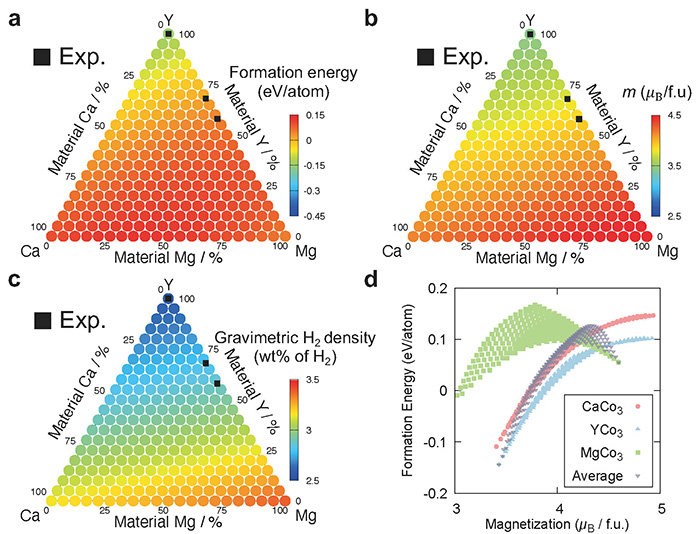
Average formation energy (a) and total magnetic moment (b) diagrams of CaxYyMg1-x-yCo3. (c) Theoretical gravimetric hydrogen density diagram of CaxYyMg1-x-yCo3H7 assuming complete hydrogenation. Formation energies are given in eV per formula unit, magnetic moments in µB per formula unit, and hydrogen densities in weight percent. Black squares indicate compounds reported in previous experimental studies. (d) Formation energy versus total magnetic moment of CaxYyMg1-x-yCo3 with CaCo3 (light-red), YCo3 (light-blue), and MgCo3 (light-green) structures. The average formation energy versus average total magnetic moment (black). ©Hung Ba Tran et al.
Beyond identifying specific high-performance alloys, the study establishes magnetism as a key design parameter for hydrogen storage materials. Rather than treating magnetic effects as a secondary property, the work shows that magnetic interactions can decisively influence alloy stability and hydrogen capacity.
The implications extend beyond hydrogen energy. Similar magnetic and electronic effects play important roles in batteries, catalysis, and other functional materials. By demonstrating how magnetism can be deliberately tuned to improve material performance, this research provides a new framework for designing advanced materials for a wide range of energy-related applications.
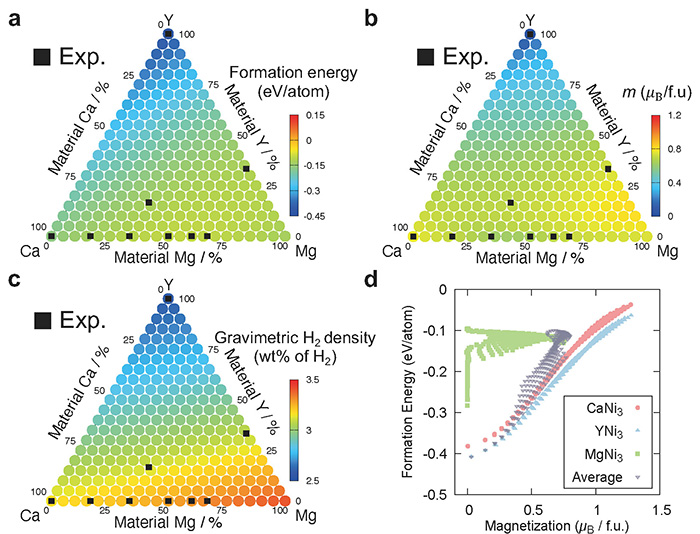
Average formation energy (a) and total magnetic moment (b) diagrams of CaxYyMg1-x-yNi3. (c) Theoretical gravimetric hydrogen density diagram of CaxYyMg1-x-yNi3H7 assuming complete hydrogenation. Formation energies are given in eV per formula unit, magnetic moments in µB per formula unit, and hydrogen densities in weight percent. Black squares indicate compounds reported in previous experimental studies. (d) Formation energy versus total magnetic moment of CaxYyMg1-x-yNi3 with CaNi3 (light-red), YNi3 (light-blue), and MgNi3 (light-green) structures. The average formation energy versus average total magnetic moment (black). ©Hung Ba Tran et al.
| タイトル: | Tuning Stability of AB3-Type Alloys by Suppressing Magnetism |
|---|---|
| 著者: | Hung Ba Tran, Toyoto Sato, Ryuhei Sato, Hiroyuki Saitoh, Shin-ichi Orimo, Hao Li |
| 掲載誌: | Chemistry of Materials |
| DOI: | 10.1021/acs.chemmater.5c02960 |
東北大学材料科学高等研究所(WPI-AIMR)
教授 Hao Li(研究者プロフィール)
| E-mail: | li.hao.b8@tohoku.ac.jp |
|---|---|
| Webstie: | Hao Li Laboratory |
東北大学材料科学高等研究所(WPI-AIMR) 広報戦略室
| Tel: | 022-217-6146 |
|---|---|
| E-mail: | aimr-outreach@grp.tohoku.ac.jp |