


March 19, 2026
International researchers entering Japanese academia have historically faced a fundamental challenge: accessing research infrastructure typically required integration into the traditional laboratory (Koza) system, where equipment ownership, research direction, and technical support flow through traditional hierarchical structures. For researchers with independent ideas seeking to establish their own research directions, this model created significant barriers—particularly when language differences complicated equipment operation and maintenance coordination.
The Common Equipment Room at the Advanced Institute for Materials Research (AIMR) at Tohoku University emerged in 2012 as one of the institutional responses to this challenge. More than a shared equipment facility, it has become a critical component in creating alternative pathways for international researchers to integrate into Japanese academia while maintaining research autonomy. The work from Dr. Siraprapha Deebansok—a young researcher originally from Thailand—exemplifies how this infrastructure enables independent research that would otherwise face substantial obstacles.
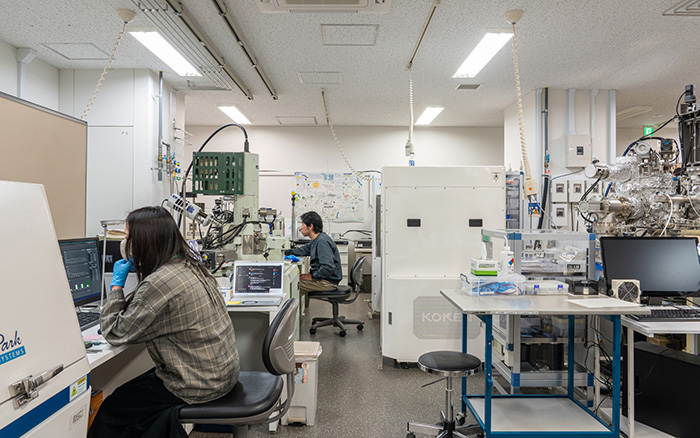
The Common Equipment Room houses six major research instruments managed by three dedicated technical coordinators who provide comprehensive research technology support. Representative capabilities include a field emission scanning electron microscope for high-resolution surface imaging, a laser Raman spectrometer for molecular characterization, and X-ray diffraction systems for structural analysis. The facility also maintains an atomic force microscope (AFM) that has proven essential for Dr. Deebansok’s operando measurement ideas—a project requiring real-time surface characterization during electrochemical operating conditions.
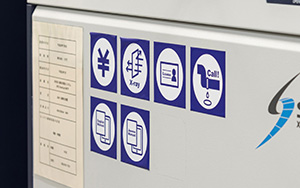
The technical coordinators— all with research backgrounds—provide support that distinguishes the facility from similar university infrastructure. They conduct equipment training, troubleshoot experimental challenges, and assist with research design considerations. Critically, the coordinators work in English, eliminating language barriers that have historically complicated equipment access for international researchers. The facility further developed original pictograms a decade ago to assist researchers unfamiliar with Japanese, demonstrating attention to practical barriers beyond equipment availability.
“Our operational model differs fundamentally from the traditional approach where individual laboratories own equipment and coordinate lending arrangements,” explains Dr. Ryotaro Kumashiro, manager of the Common Equipment Room. “When researchers require capabilities unavailable at AIMR, we coordinate access to shared equipment across Tohoku University.”
When Prof. Motoko Kotani assumed directorial leadership of AIMR in 2012, she recognized that international research collaboration required more than recruiting foreign researchers—it demanded infrastructure that could accommodate different research cultures and operational expectations. The Common Equipment Room emerged from this recognition.
Japanese research institutions traditionally operated through individual laboratory equipment ownership, with borrowing arrangements coordinated directly between labs. While functional within established research networks, this system created obstacles for newcomers from outside Japan. Finding which laboratory possessed needed equipment, negotiating usage terms, and coordinating schedules presented hurdles even before addressing technical training requirements. For international researchers unfamiliar with institutional networks and facing language barriers during equipment operation, these challenges could significantly slow research progress.
The Common Equipment Room began modestly, with a single technical staff member coordinating equipment access and managing logistical challenges. The facility gradually acquired instruments through a combination of donations and strategic purchases. Responding to user feedback, it evolved beyond equipment provision to include comprehensive support infrastructure—maintaining tool inventories, stocking various fastener sizes, and developing systems to minimize researcher burden.
By 2015, the Common Equipment Room introduced usage fees to balance operational costs with researcher accessibility, reflecting maturation from experimental initiative to sustainable infrastructure. The staff expanded to three full-time technical coordinators, shifting from primarily coordination work to active equipment management and research support.
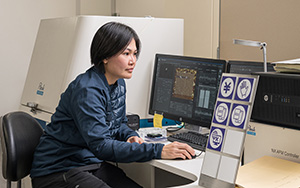
The Common Equipment Room’s role in supporting international researchers becomes concrete in Dr. Siraprapha Deebansok’s work. Selected through the competitive Core Research Cluster for Materials Science (CRC-MS, directed by Prof. Shin-ichi Orimo), Dr. Deebansok joined AIMR with research ideas requiring sophisticated instrumentation but no affiliation with a traditional laboratory structure possessing such equipment.
The CRC-MS exemplifies the move beyond the Koza system. This inter-departmental organization selects a number of international applicants through competitive proposal review*. Selected researchers pursue independent research directions while receiving extensive organizational support, including career development. One CRC-MS researcher, Dr. Mehrdad Elyasi, was appointed as an AIMR Junior PI in 2025, illustrating how this pathway can enable international researchers to prove concepts through autonomous work rather than vertical laboratory integration.
“The first step of my project aims to prove the operando electrochemical AFM concept: a functional instrument that can image an electrochemical surface reaction,” explains Dr. Deebansok. Working with collaborators, she designed and built a custom portable electrochemical cell specifically engineered to mount on the Common Equipment Room’s AFM. This custom apparatus enables simultaneous surface mapping and mechanical property measurement in liquid environments while offering a level of experimental flexibility—capabilities not available through standard commercial systems under diverse user-defined operating conditions.
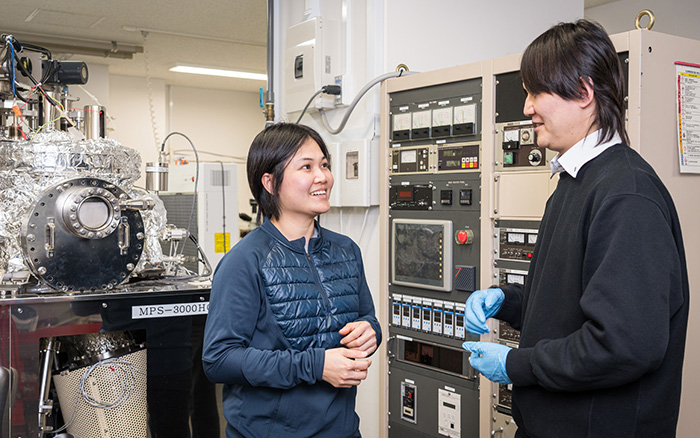
Technical coordinators provide essential support, ranging from equipment training to experimental troubleshooting, enabling complex projects to move forward
“Because I cannot afford an instrument like AFM at this stage of my career, the Common Equipment Room made the project even possible,” Dr. Deebansok notes. As the facility’s most frequent AFM user, she progressed from minimal prior AFM experience to designing custom instrumentation around the instrument. Her portable cell has since been tested at other institutions’ AFMs, demonstrating reproducible results across different instruments—she is currently preparing these results for publication.
Dr. Deebansok’s research workflow also illustrates how researchers navigate the broader facility ecosystem beyond AIMR. While the Common Equipment Room provided AFM capabilities, she accessed X-ray photoelectron spectroscopy at a facility in a different building through Tohoku University’s Core Facility Center—a university-wide system for coordinating shared equipment access. This integration across departments enabled the comprehensive characterization her research required.
The technical staff’s English-language support proved essential throughout. Equipment training, experimental troubleshooting, and technical consultation occurred without language barriers that might otherwise complicate sophisticated custom apparatus development.
* Currently, the five international researchers hired through CRC-MS were selected out of 129 applicants in two recruitment rounds.
While Dr. Deebansok’s experience demonstrates the Common Equipment Room fulfilling its core mission, maintaining this level of support presents ongoing challenges.
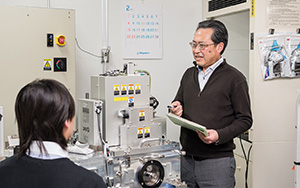
“More than 10 years have passed since its establishment, and the frequency of troubles has increased, so we are dedicating considerable effort to handling them,” Dr. Kumashiro notes. Equipment aging requires increasing attention as the facility balances high usage rates with measurement reliability and equipment longevity. Booking processes must accommodate frequent users while maintaining access for occasional needs. Maintenance scheduling must minimize research disruption while addressing the reality that near-continuously operating instruments require more frequent servicing.
The growing international researcher population creates sustained demand for meticulous support. The technical coordinators’ research backgrounds enable them to engage substantively with experimental design questions rather than merely providing operational instructions. This depth of support—from equipment training through research theme exploration—reduces burden on supervising professors while maintaining research quality. As Dr. Kumashiro emphasizes, “We want to continue to help researchers achieve what they want to do”—a service philosophy that has guided the facility throughout its thirteen-year evolution.
The Common Equipment Room’s significance extends beyond AIMR to broader transformations in Japanese research infrastructure. When Tohoku University received designation as Japan’s first University for International Research Excellence, the recognition came with substantial funding and a mandate: transition from the traditional Koza system to Principal Investigator-based structures.
This shift makes shared equipment facilities essential. Where the Koza system concentrated equipment ownership within traditional laboratories, PI-based systems require researchers to access instrumentation across institutional boundaries.
The convergence of multiple initiatives reflects broader transformation in Japanese research infrastructure. Tohoku University’s Core Facility Center operates on similar principles of centralized coordination and professional support for shared equipment access. Combined with CRC-MS’s competitive pathway and International Research Excellence funding enabling international researcher hiring, these developments have created systemic change. Where international researchers previously faced limited integration pathways outside traditional laboratories, visible alternatives now exist.
Dr. Deebansok’s progression from CRC-MS selection to high impact publication preparation demonstrates this pathway in practice. What might appear as merely shared infrastructure becomes, when combined with other institutional changes, a catalyst for transforming academic tradition. International researchers can now contribute to Japanese academia while maintaining research autonomy.
(Author: Patrick Han)
 In the Spotlight