



When looking to the future of information technology, researchers have pinpointed a once-theoretical particle-like structure: the skyrmion. Magnetic skyrmions are very stable structures found on micromagnetic materials that have a vortex-like spin. Because they can be moved with minimal electrical current, these structures could help develop memory to power the next generation of computing without consuming a lot of power.
But until recently, the fundamental properties of the skyrmion remained a mystery to researchers. In a paper published in Nature Communications on April 13, 2026, researchers shared new details and properties about these structures.
“Skyrmions are highly stable and move with minimal electrical current, paving the way for next-generation memory with extremely low power consumption. It’s the ultimate miniaturization, utilizing ‘world-class’ 2-nanometer structures will allow ultra-high-density data storage and much smaller electronic devices,” said Kosuke Nakayama, a professor at Tohoku University in Sendai, Japan.
Previously, researchers believed that skyrmions could only form on asymmetric crystal structures. But these tiny skyrmions, which are around 2 nanometers in diameter, are found on centrosymmetric materials like Eu(Ga,AI)4. To understand these structures and how they form with their vortex structure, precise composition-controlled crystals of Eu(Ga,AI)4 were synthesized and then investigated with an angle-resolved photoemission spectroscopy (ARPES).
When observing the skyrmion-host centrosymmetric material, researchers saw an important trigger that helped form the skyrmion: a Lifshitz transition, which is a sudden change in electronic states. When this change in electronic states happens, it produces overlapping Fermi surfaces or nesting Fermi surfaces. “This is like a design blueprint, acting as the precise structural blueprint for skrymion size and arrangement,” said Nakayama.
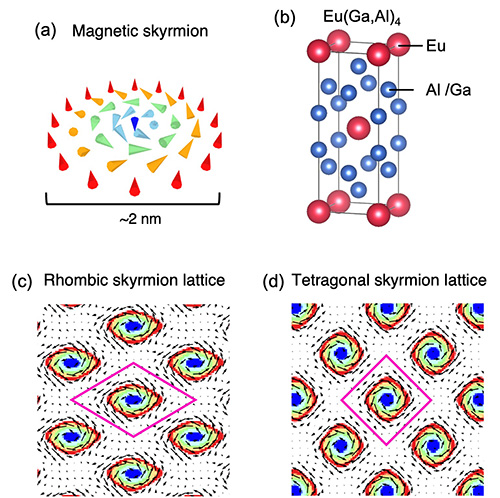
(a) Schematic of magnetic skyrmion with an exceptionally small diameter. (b) Crystal structure of Eu(Ga,Al)4. (c), (d) Schematic illustrations of field-induced rhombic and square skyrmion-lattice states. ©Yuki Arai et al.
Researchers also definitively answered the question of what creates the skyrmion vortices, challenging what was previously theorized about these structures. It is an interaction called the RKKY interaction, which is an abbreviation of Ruderman-Kittel-Kasuya-Yosida interaction. Previously it was assumed that a different interaction called the Dzyaloshinskii-Moriya interaction. The RKKY interaction, powered by conduction electrons, explains the nesting Fermi surfaces, the lattice structure, and the tiny size of the skyrmion.
Understanding the Lifshitz transition, the RKKY interaction, and how the magnetic material is able to develop a skyrmion, has important implications for nanocomputing. “This shift allows scientists to ‘design’ magnetic properties at will by manipulating electronic foundations, rather than relying on trial and error,” said Nakayama.
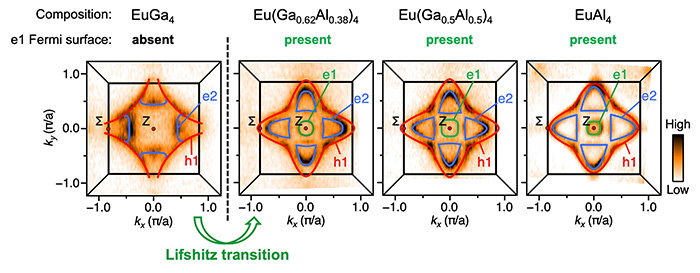
Composition-dependent ARPES intensity maps measured for Eu(Ga,Al)4. Red, blue, and green lines are guides for the eyes to trace the experimental Fermi surfaces h1, e2, and e1, respectively. The change in the Fermi surface (i.e., the appearance/disappearance of e1 Fermi surface) between EuGa4 and Eu(Ga0.62Al0.38)4 signifies a Lifshitz transition. ©Yuki Arai et al.
In order for this study to come to fruition, two different labs had to work closely together to make the experiment a success. “The breakthrough in this study was made possible by the synergy between the Kyoto Sangyo University group, which synthesized the high-quality single crystals with precise composition control, and the Tohoku University group, which performed the advanced SX-ARPES experiments,” said Nakayama.
Looking ahead, researchers are looking to all the different ways they can utilize skyrmion for nanocomputing, from manipulating electronic states to create skyrmions in different sizes and shapes to controlling material structure to create even smaller structures. “A key goal is to develop new materials that can operate at higher temperatures, which is essential for making these ultra-power-saving devices practical for everyday use,” said Nakayama. “We will utilize the ‘design blueprint’ identified in this study—specifically the relationship between Fermi surface nesting and magnetic structures—to guide future material development.”
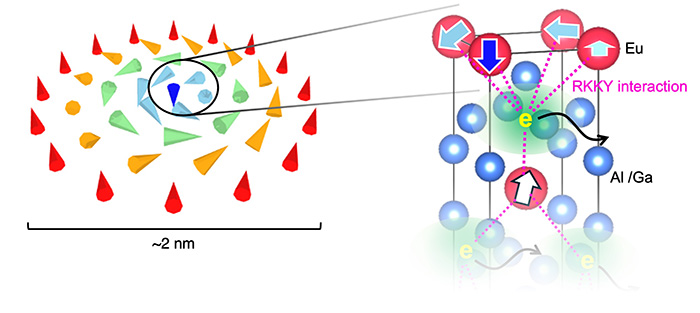
Schematic of the skyrmion formation mechanism. Left panel is reproduction of Fig. 1(a). Right panel shows a magnified view of the four spins circled in left panel. The orientations of these spins (indicated by blue and light blue arrows) are governed by the RKKY interaction mediated by conduction electrons (green shade). ©Yuki Arai et al.
| Title: | Origin of multiple skyrmion phases in EuAl4 |
|---|---|
| Authors: | Yuki Arai, Kosuke Nakayama, Asuka Honma, Seigo Souma, Daisuke Shiga, Hiroshi Kumigashira, Takashi Takahashi, Kouji Segawa, and Takafumi Sato |
| Journal: | Nature Communications |
| DOI: | 10.1038/s41467-026-71020-y |
Kosuke Nakayama, Takafumi Sato (Profile of Prof. Sato)
Tohoku University
| E-mail: | k.nakayama@arpes.phys.tohoku.ac.jp t-sato@arpes.phys.tohoku.ac.jp |
|---|---|
| Webstie: | stableo Lab website |