



A compass always points north – or does it? Magnets normally maintain a stable direction of magnetization, pointing from south to north (→N). However, this direction can change under strong magnetic fields or heat. For example, a compass placed near a strong magnet may no longer point in the right direction. Magnets can also lose their magnetism when exposed to high levels of heat. This isn’t just relevant to wayfinding during your camping trips – if the magnets in hard drives and memory storage devices are affected, it could mean losing all of your precious data.
Researchers at Tohoku University sought to better understand the intricate ways in which this thermally-activated switching occurs in nanomagnets, and successfully measured it experimentally for the very first time.
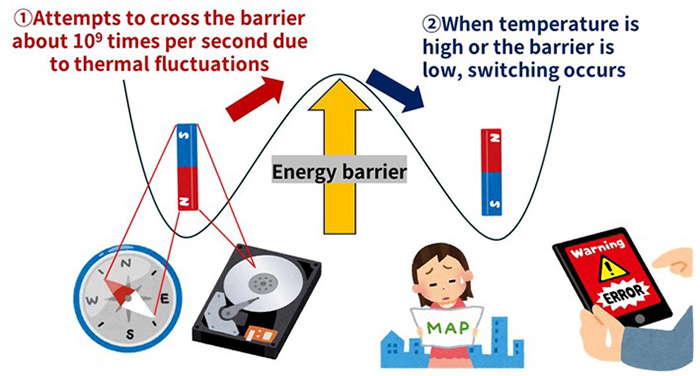
Energy barrier model of magnetization switching. Two stable magnetization states are separated by an energy barrier. Thermal fluctuations occasionally allow the magnetization to cross the barrier, causing switching. ©Shun Kanai
This switching behavior can be understood using something called an energy landscape. Two stable magnetization directions exist (such as south and north), separated by an energy barrier. Thermal fluctuations can occasionally push the magnetization over this barrier, causing the direction to switch.
This stability is the principle behind magnetic storage technologies such as hard disk drives. In these devices, each bit of information is stored in a tiny magnet. The height of the energy barrier is proportional to the volume of the magnet. As storage density increases and the magnets become smaller, the barrier becomes lower, increasing the risk that thermal fluctuations may flip the magnetization and destroy stored information.
The probability of such thermally activated switching follows the Arrhenius law. In this model, the magnet repeatedly attempts to cross the energy barrier with a characteristic time called the attempt time (τ0). For nearly 70 years, this attempt time has been assumed to be about one nanosecond. However, it had never been successfully measured experimentally.
To measure attempt time, the research team fabricated nanomagnet devices, characterized their geometry using scanning electron microscopy (SEM), and measured the way they responded – such as how it switches between two opposite magnetization states at room temperature.
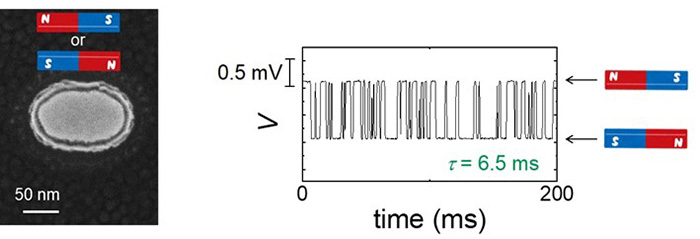
Left: Scanning electron microscopy (SEM) image of a fabricated nanomagnet device (scale bar: 50 nm). The magnetization of the nanomagnet can take two opposite orientations. Right: Representative random telegraph noise (RTN) signal measured at room temperature. The voltage switches between two discrete levels, reflecting thermally activated magnetization reversal between the two states. ©Shun Kanai
The researchers developed a new experimental and analytical approach that allows the Arrhenius law to be tested without changing temperature. Using this approach, they found that the attempt time is about 4–11 nanoseconds, which is more than ten times longer than previously assumed.
“This parameter has been assumed for decades but had never been directly measured,” says Shun Kanai, Associate Professor at the Research Institute of Electrical Communication (RIEC) at Tohoku University. “Our experiments show that the fundamental switching attempts of nanomagnets occur much more slowly than previously thought.”
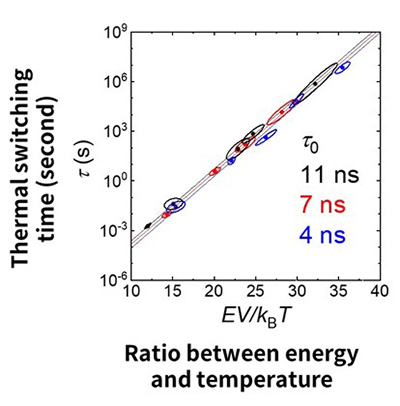
Experimental determination of the attempt time. The energy barrier was systematically controlled by varying nanomagnet size and magnetic fields. The resulting Arrhenius plot allowed the attempt time τ0 to be determined under constant temperature conditions. ©Shun Kanai
The study also suggests that collective spin excitations inside the magnet, known as spin waves, influence the switching process and slow down the effective switching attempts.
Now that attempt time has been experimentally measured, this value can serve as a more accurate foundation for further developing and evaluating the stability of magnetic devices such as hard disk drives and magnetoresistive random access memory. Emerging computing technologies like spintronic probabilistic computing devices (p-bits) which intentionally use thermal fluctuations may also benefit from this finding.
The results were published in Communications Materials on April 21, 2026.
This work is supported, in part, by JST-PRESTO Grant No. JPMJPR21B2, JST-CREST Grant No. JPMJCR19K3, JSPS Kakenhi Grant Nos. 19H05622, 19H00645, 20H02178, 21K13847, and 22H04965, MEXT X-NICS JPJ011438, Shimadzu Science Foundation, Takano Research Foundation, and Cooperative Research Projects of RIEC.
| Title: | Stochastic switching time constant and instability in nanomagnets |
|---|---|
| Authors: | Shun Kanai, Keisuke Hayakawa, Mehrdad Elyasi, Keito Kobayashi, Junta Igarashi, Butsurin Jinnai, William A. Borders, Gerrit E.W. Bauer, Hideo Ohno, and Shunsuke Fukami |
| Journal: | Communications Materials |
| DOI: | 10.1038/s43246-026-01149-2 |
Shun Kanai (Profile of Dr. Kanai)
Research Institute of Electrical Communication (RIEC), Tohoku University
| E-mail: | skanai@tohoku.ac.jp |
|---|---|
| Webstie: | Fukami-Kanai Laboratory website |