


A new artificial intelligence (AI) tool that could make it much easier to discover better materials for clean energy technologies. The system, called StableOx-Cat, helps scientists identify stable metal oxide electrocatalysts— materials that play a key role in processes such as water splitting and fuel production.
Electrocatalysts are essential for many energy technologies, but finding ones that are both effective and stable is a major challenge. There are countless possible materials and testing them one by one is time-consuming and complex. While large scientific databases and computational tools exist, they often require specialized programming skills to use effectively.
StableOx-Cat addresses this problem by allowing researchers to interact with advanced computational tools using simple, everyday language. Instead of writing code, users can ask questions, and the AI agent translates those questions into structured scientific analyses.
The system combines a large language model (LLM) with physics-based methods that ensure scientific accuracy. It can evaluate whether a material is stable under different conditions, such as changes in acidity (pH) or electrical potential, which are critical factors in real-world applications.
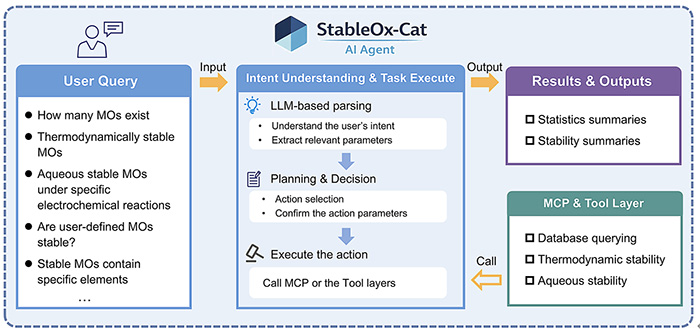
Overall architecture of the StableOx-Cat AI Agent. AI: Artificial intelligence; MOs: metal oxides; MCP: Model Context Protocol. ©Hao Li et al.
By grounding its analysis in well-established physical principles, StableOx-Cat avoids the risk of generating misleading or incorrect results, a common concern with AI systems. This makes it a reliable tool for researchers seeking trustworthy insights.
“StableOx-Cat lowers the barrier to entry for advanced materials analysis,” said Hao Li, Distinguished Professor at Tohoku University’s Advanced Institute for Materials Research (WPI-AIMR). “By combining natural language interaction with rigorous scientific evaluation, we enable more researchers to explore complex chemical spaces efficiently and confidently.”
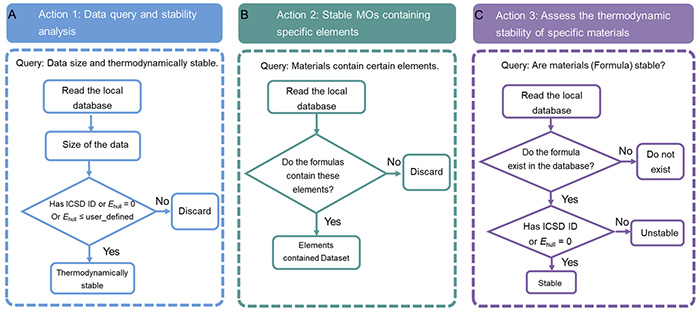
Functional architecture for the analysis of thermodynamically stable MOs, including (A) data query and stability analysis, (B) stable MOs containing specific elements, and (C) assessing the thermodynamic stability for specific MOs. MOs: Metal oxides; ICSD: Inorganic Crystal Structure Database; ID: identifier. ©Hao Li et al.
The platform can analyze materials across a wide range of conditions, covering different pH levels and electrical potentials. This flexibility allows scientists to simulate realistic environments and identify candidates that are more likely to succeed in experiments.
Beyond metal oxides, the framework is designed to be adaptable. It can be extended to study other types of materials, such as alloys, nitrides, and carbides, making it a versatile tool for a broad range of applications in chemistry and materials science. Details of the findings were published in the journal AI Agent on March 27, 2026.
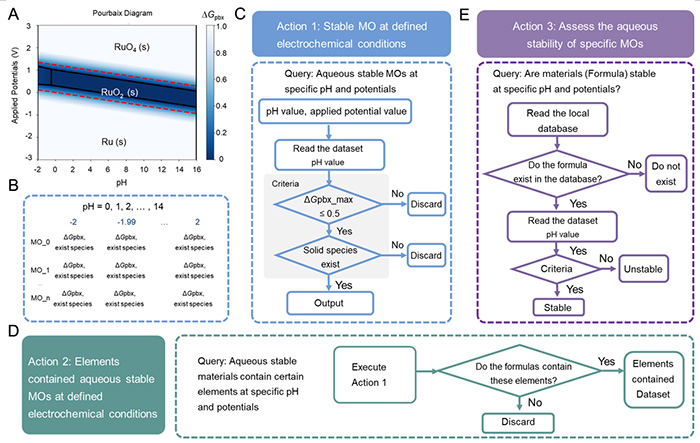
(A) A representative bulk Pourbaix diagram of RuO2; (B) The dataset information for the aqueous analysis. The functional architecture for the analysis of aqueous stable MOs, including (C) stable MOs analysis, (D) stable MOs containing specific elements analysis, and (E) assessing the aqueous stability for specific MOs at defined electrochemical conditions. MOs: Metal oxides. ©Hao Li et al.
| Title: | StableOx-Cat agent: an AI agent for exploring stable metal oxide electrocatalysts |
|---|---|
| Authors: | Xue Jia, Di Zhang, Yiming Lu, Qian Wang, and Hao Li |
| Journal: | AI Agent |
| DOI: | 10.20517/aiagent.2026.03 |
Hao Li (Profile of Dr. Li)
Advanced Institute for Materials Research (WPI-AIMR), Tohoku University
| E-mail: | li.hao.b8@tohoku.ac.jp |
|---|---|
| Webstie: | Hao Li Laboratory |