



Bonding lithium metal to a ceramic surface should be a dream team combination for creating solid-state lithium metal batteries. However, getting them to bond is the hard part. Impurity layers tend to form on the surface, which hinders a process called wetting that is crucial to the adherence of metals and ceramics. To get these two materials with very different characteristics to bond, a different strategy was needed. Researchers at Tohoku University’s Advanced Institute for Materials Research (WPI-AIMR) thought outside the box, finding that ultrasonic welding brought these two materials together.
“This is an underexplored method in our field. Applying ultrasonic welding to bond lithium metal directly to a garnet-type oxide electrolyte is, to our knowledge, unprecedented in this context,” remarks Eric Jianfeng Cheng (WPI-AIMR).
The research describing this exciting new implementation strategy – which may help create more efficient and practical solid-state energy storage technology than conventional lithium-ion batteries – was published in Small Structures on March 19, 2026.
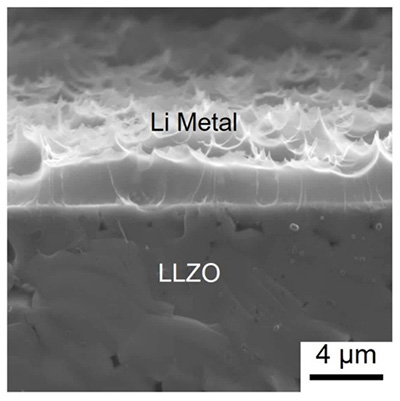
Cross-sectional Li–LLZO interfacial morphologies obtained by ultrasonic welding in seconds at room temperature. ©Eric Jianfeng Cheng et al.
Solid-state lithium metal batteries are widely regarded as a promising next-generation energy storage technology. Among solid electrolytes, the garnet-type oxide Li7La3Zr2O12 (LLZO) has attracted particular attention because of its high ionic conductivity and chemical stability. However, establishing intimate physical contact between lithium metal and the ceramic electrolyte (Li7La3Zr2O12 or LLZO) is difficult. The stiff, irregular shapes of a marble slab and a metal sheet interface are challenging to bond mainly because both surfaces readily form insulating Li2CO3 layers when exposed to air. This occurs for the Li metal surface in particular and creates a barrier of sorts that blocks Li-ion transport and hinders wetting.
Ultrasonic welding (USW), a mature industrial technique widely used for joining metallic components, offers a solution that is fundamentally different from conventional strategies (which are costly and process-intensive). The results of this study demonstrate that USW can form intimate lithium–LLZO interfaces within seconds at room temperature. The ultrasonic vibration disrupts insulating surface layers such as Li2CO3, while controlled pressure and high-frequency oscillation enable lithium metal to plastically deform and conform to the rigid LLZO surface, eliminating interfacial voids and establishing direct solid-state contact without melting or thermal activation.
Using USW alone, the interfacial resistance was reduced to approximately 225 Ω·cm2. When combined with a thin sputtered Au interlayer, the resistance further decreased to about 1.5 Ω·cm2, placing it among the lowest values reported for room-temperature processed Li–LLZO interfaces. Symmetric cell testing confirmed its practical feasibility as well.
This rapid, room-temperature bonding strategy provides a manufacturing-friendly and efficient pathway for oxide-based solid-state batteries. This work contributes to the development of safer and higher-energy batteries for electric vehicles, renewable energy storage, and portable electronics.
The findings were published in Small Structures on March 19, 2026.
| Title: | Ultrasonic Welding of Garnet Solid Electrolytes to Lithium Metal: Achieving Intimate Interfacial Contact in Seconds |
|---|---|
| Authors: | Mikihisa Fukuda, Ying Li, Run-Zi Wang, Shin-ichi Orimo, Yutaka S. Sato, Hidemi Kato, Eric Jianfeng Cheng |
| Journal: | Small Structures |
| DOI: | 10.1002/sstr.202500866 |
Eric Jianfeng Cheng (Profile of Cheng)
Advanced Institute for Materials Research (WPI-AIMR)
Core Research Cluster for Materials Science (CRC-MS)
| E-mail: | ericonium@tohoku.ac.jp |
|---|---|
| Webstie: | Eric Jianfeng Cheng website |