


April 27, 2026
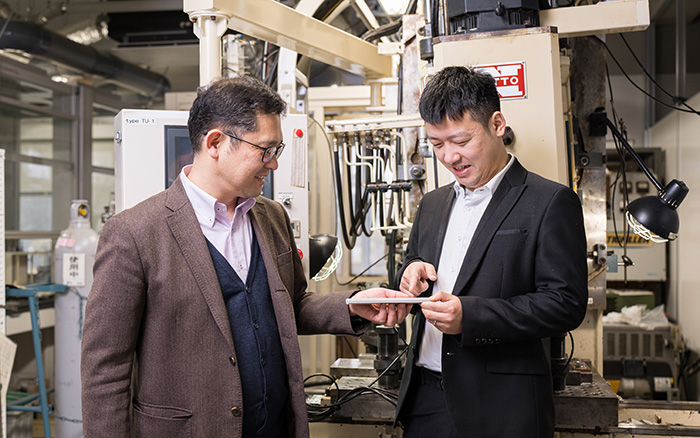
Dr. Yutaka S. Sato (left) and the corresponding author, Dr. Run-Zi Wang
A longstanding challenge in materials engineering has been how to extend the fatigue life of critical nickel-based superalloy structures (e.g., Inconel 718) that contain holes. These hole structures, commonly used for bolts and fasteners in rotating parts, create stress concentration sites that are prone to cracks and failure under repeated stresses of high-temperature operation.
Current hole-strengthening techniques, including a range of peening and cold expansion processes, work by introducing compressive residual stress (CRS) and plastic deformation into the material near the hole wall, thereby enhancing surface integrity.
However, each approach comes with trade-offs: peening processes can increase surface roughness in ways that partially negate fatigue benefits, while cold expansion processes tend to produce non-uniform plastic deformation and material accumulation around the hole edge.
Moreover, the detailed relationship between surface integrity evolution and fatigue life, particularly at high temperatures, remains poorly understood.
In a 2025 article, Run-Zi Wang and his research team at AIMR investigated whether an efficient expansion treatment could enhance the fatigue performance of Inconel 718 hole structures1. Their work evaluated a new strengthening process and systematically compared the surface integrity and high-temperature fatigue behavior of treated and untreated specimens, with the specific goal of identifying which surface factor plays the primary role in fatigue life improvement.
“In this work, we introduced a method called Hertz contact rotation expansion processing (HCR-EP), which applies controlled Hertzian contact through a rotating indenter to expand the hole wall,” explains Wang. “This approach produced more uniform plastic deformation and a deep CRS layer while minimizing both surface damage and material accumulation associated with conventional techniques.”
High-temperature fatigue tests demonstrated that HCR-EP-treated specimens showed substantial fatigue life improvements over untreated ones, particularly in the high-cycle fatigue regime.
To investigate which factor governs fatigue life improvement, the team used interrupted fatigue tests, in which specimens were paused at different stages of their fatigue life for surface integrity measurements. They found that while the plastic deformation layer and microhardness remained stable throughout, only CRS relaxed progressively during cycling, indicating its dominant mechanistic role.
“Our findings represent a shift in fatigue research, from passively measuring and predicting damage to actively reshaping the material state at hole structures in order to prevent crack initiation in the first place,” says Wang. “These results offer a practical and mechanistically grounded route to longer-lasting high-temperature components.”
A future direction involves developing an AI-enabled framework that links processing parameters, surface state, and service performance into a closed-loop workflow for scalable, data-informed reliability design.
What surprised me most was how strongly the effectiveness of HCR-EP depends on service severity. Clear fatigue life gains appear under milder conditions but diminish as loading becomes harsher. This means hole strengthening is not a one-size-fits-all solution; it must be matched to the actual operating regime. Interestingly, peers have been most struck by the broader implication: that manufacturing can be used for active damage regulation, not just strength improvement. That reframes fatigue from a problem to be predicted into one that can be engineered against through controllable surface states.
(Author: Patrick Han)
This research highlight has been approved by the authors of the original article and all information and data contained within has been provided by said authors.

 Research Highlights