


January 26, 2026

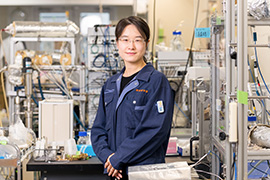
Dr. Chunli Han, the corresponding author of this research paper
The search for better oxygen carriers has long centered on one key question: how can we design metal oxides that can reversibly store and release lattice oxygen efficiently at lower temperatures? This reversible behavior underpins clean-energy technologies such as fuel conversion, CO2 capture, and chemical looping for hydrogen production, where reaction feasibility and efficiency depend directly on a material’s oxygen storage and release capacity (OSC).
Among these candidate materials, doped ceria (CeO2) has been a particularly promising system for achieving high and tunable oxygen mobility.
However, researchers struggled to connect OSC property with the detailed local structure and chemical state of doped ceria nanoparticles. Traditional synthesis methods could not precisely control dopant inclusion state, dispersion, or valence, leading to inconsistent samples and obscuring the mechanisms behind oxygen storage and release at different temperatures.
In a 2025 article1, an AIMR research team led by Chunli Han, Akira Yoko, and Tadafumi Adschiri addressed this challenge through a continuous-flow hydrothermal synthesis method capable of producing ultrasmall Mn-doped CeO2 nanoparticles with tightly controlled structural and chemical features. This approach enabled rapid heating, mixing, and quenching—on timescales of milliseconds to seconds—allowing the authors to tune Mn inclusion state (in or out of the CeO2 lattice) and chemical state with unusual precision.
A key innovation was the precise thermodynamic and kinetic co-control of the dopant-host atom assembly and distribution based on the swift start-up flow hydrothermal synthesis system.
“By controlling the residence time and relative precipitation rates of the Mn and Ce precursors, we could stabilize CeO2 nanoparticles smaller than five nanometers while capturing diverse Mn environments,” explains Han. “This includes lattice-substituted Mn atoms, surface Mn species, and phase-segregated MnOx—local structures that conventional batch syntheses cannot reliably produce.”
The resulting Mn–CeO2 nanoparticles exhibited a fourfold increase in low-temperature (<300 °C) OSC compared with particles made by batch methods. The work also showed that low-temperature OSC is mainly enhanced by Mn2+ substitution in the CeO2 lattice and surface Mn species, whereas high-temperature (≥300 °C) OSC correlates with overall Mn and Ce3+ concentrations, regardless of how Mn is incorporated into the CeO2.
These findings demonstrate that precise control over dopant valence and local structure is essential for uncovering the mechanisms behind oxygen storage and release and for designing higher-performing low-temperature oxygen carriers. More broadly, the study highlights continuous-flow synthesis as a controllable and scalable route to functional nanoparticles and underscores the importance of precise materials synthesis for advancing both practical applications and fundamental understanding.
What stood out most to me in this project was realizing how much control we could gain by shifting from traditional thermodynamic thinking to process-based kinetic control at the millisecond scale. Instead of focusing only on nanoparticle size and shape, we began controlling the atom distribution, ordering, coordination, and chemical state by precisely controlling the reaction field—mixing, heat and mass transfer, and kinetic pathways. This opens the door to uncovering many of the “black boxes” in batch synthesis. And because continuous-flow methods are reproducible and scalable, I believe this approach will help bridge the gap between laboratory discoveries and real-world applications much more quickly.
(Author: Patrick Han)
This research highlight has been approved by the authors of the original article and all information and data contained within has been provided by said authors.

 Research Highlights