


Artificial intelligence (AI) is transforming the way scientists discover and design new materials. In a specially invited review published in Angewandte Chemie International Edition, Tohoku University researchers have highlighted how large AI models are redefining catalyst discovery and paving the way for faster, smarter innovation in clean energy and sustainable technologies.
Catalysts are materials that speed up chemical reactions and are essential for processes ranging from fuel cells to pollution control and hydrogen production. Traditionally, discovering new catalysts has relied heavily on trial and error—an approach that can take years of laboratory work and significant resources.
The new review outlines a fundamentally different strategy. By combining large, high-quality catalysis databases with advanced artificial intelligence tools—particularly universal machine learning interatomic potentials (MLIPs) and large language models (LLMs)—scientists can now explore vast chemical spaces and predict catalytic performance before materials are even synthesized.
Universal MLIPs allow researchers to simulate how atoms behave and interact with remarkable speed and accuracy. At the same time, LLMs can analyze scientific literature, interpret complex knowledge, and even help design new research directions. Together, these tools connect scientific concepts, computational modeling, and experimental validation into a unified, data-driven workflow.
This integrated approach significantly accelerates discovery. Instead of testing one material at a time, researchers can perform large-scale simulations, efficiently gather and train data, and rapidly predict which catalyst designs are most promising. In some cases, AI systems can even guide their own next research steps, creating a self-improving cycle of learning and experimentation.
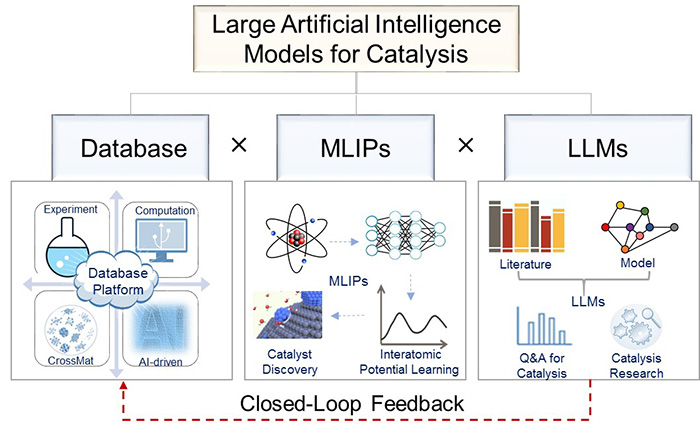
AI-empowered catalysis research via integrated database platform, universal machine learning interatomic potentials (MLIPs), and large language models (LLMs). ©Di Zhang et al.
“By integrating universal AI models with domain knowledge and automation, we are moving toward a future where catalyst discovery becomes a continuously accelerating process rather than a slow, incremental one,” said Hao Li, a Distinguished Professor at Tohoku University's WPI-AIMR. “This shift has the potential to dramatically shorten the time between scientific insight and real-world application.”
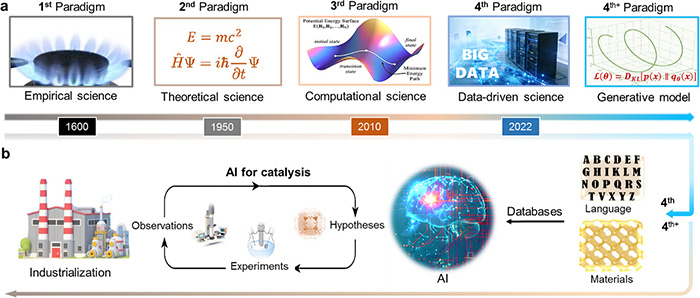
Catalysis research paradigms. ©Di Zhang et al.
Looking ahead, the team envisions fully integrated, AI-powered closed-loop platforms. In such systems, prediction, synthesis, testing, and learning would operate in a continuous feedback cycle. These platforms could dramatically reduce wasted time and materials while increasing the likelihood of breakthrough discoveries.
Beyond catalysis, the researchers plan to expand these strategies to other critical materials fields, including batteries and hydrogen storage materials. By building cross-disciplinary digital materials ecosystems, they aim to foster innovation across multiple energy technologies.
The review marks a milestone in AI-driven materials science and recognizes Li’s leading contributions to the field. As large AI models, multimodal systems, and automation technologies continue to advance, they signal the dawn of a new era in which catalyst materials discovery is not only faster—but perpetually accelerating.
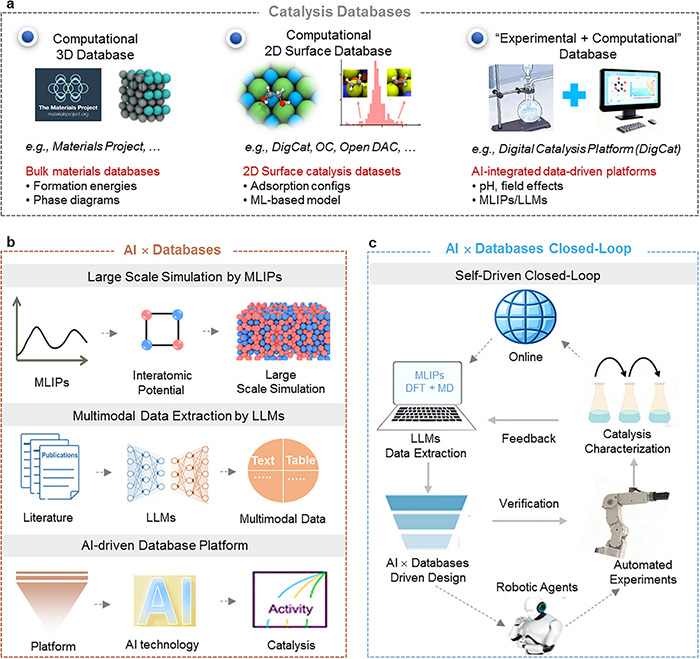
Database for catalysis science. ©Di Zhang et al.
| Title: | Accelerating Catalyst Materials Discovery With Large Artificial Intelligence Models |
|---|---|
| Authors: | Di Zhang, Yuanzheng Chen, Chuanyu Liu, Yan Liu, Hongliang Xin, Jiayu Peng, Pengfei Ou, Hao Li |
| Journal: | Angewandte Chemie International Edition |
| DOI: | 10.1002/anie.202526150 |
Di Zhang (Profile of Dr. Zhang)
Advanced Institute for Materials Research (WPI-AIMR), Tohoku University
| E-mail: | di.zhang.a8@tohoku.ac.jp |
|---|
Hao Li (Profile of Dr. Li)
Advanced Institute for Materials Research (WPI-AIMR), Tohoku University
| E-mail: | li.hao.b8@tohoku.ac.jp |
|---|---|
| Webstie: | Hao Li Laboratory |