



August 24, 2026
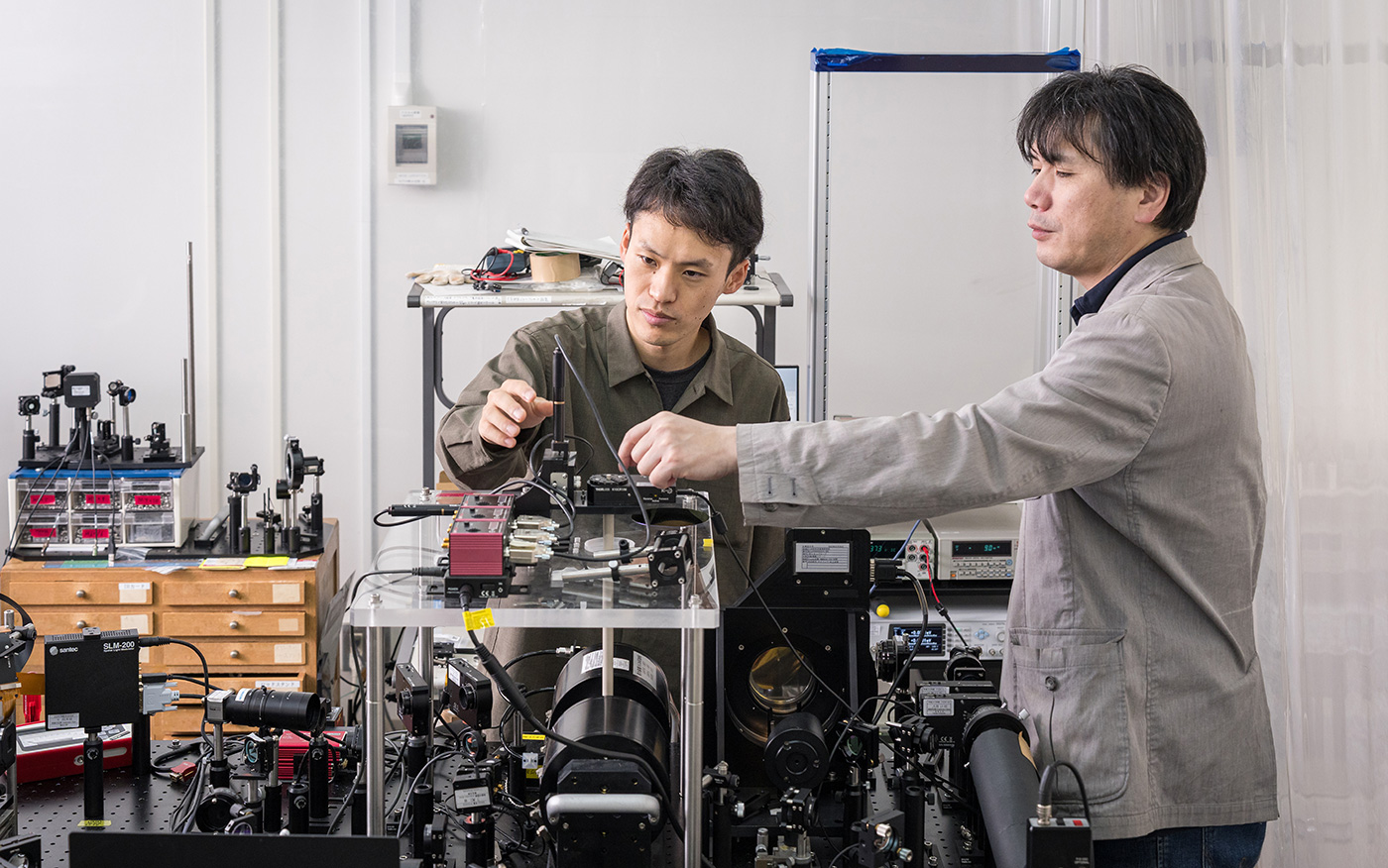
Mr. Koki Nukui (left) and Dr. Shigemi Mizukami, the corresponding author of this research paper
When circularly polarized light strikes a ferromagnetic metal, it can nudge the material’s magnetization into motion. For decades, this behavior has been explained by the “inverse Faraday effect (IFE),” in which light acts briefly like a magnetic field aligned with the light wavevector. Recent theoretical work points to a different mechanism behind this phenomenon: the orbital angular momentum (OAM) carried by electrons within the metal itself.
However, confirming this new idea has been difficult. Traditional IFE models account for many observed patterns of light-induced magnetization, leaving little room to unveil a distinct OAM contribution. Light can also generate spin angular momentum, making it difficult to separate its effects from those of OAM.
“For years, helicity-driven torques in metals were explained by different physical pictures depending on the structure: IFE for bulk ferromagnets, and optical orientation of spin for multilayer structures,” explains Shigemi Mizukami, the principal investigator of an AIMR research team. “We wondered what would happen in an alloy, where that distinction isn’t so clear-cut.”
In a 2025 article, Mizukami and his team set out to test this idea directly, turning to ferromagnetic alloy thin films to look for signatures of light-induced OAM in magnetization dynamics1.
The researchers selected CoPt alloy thin films, whose Pt content tunes the strength of spin-orbit coupling (SOC). Tracking the amplitude and initial phase of magnetization precession driven by circularly polarized femtosecond pulses, they separated the light-induced torque into its field-like and damping-like components and compared them with their OAM-based model.
One key result was the measurement of a substantial damping-like torque whose strength grew steadily with the Pt content, tracking the increasing SOC. This observation matched their OAM-based model and revealed a phenomenon that the traditional IFE models, predicting the magnetic field aligned with the light wavevector, cannot account for on their own.
The measurements also showed a change in the magnetization’s motion. As Pt content increased, the precession shifted from a sine-like oscillation toward a more cosine-like one, again consistent with the model and reflecting the growing dominance of the damping-like torque.
“What surprised us most was that such a simple model, based on OAM, reproduced our experimental trends so closely,” says Mizukami. “It tells us that angular momentum transfer through SOC—not the conventional effective-field picture—is behind what we’re seeing. We also see a concrete link between orbitronics and optomagnetism, two fields that have been developing somewhat separately.”
The team is now working to build a fuller theory of how light-induced OAM forms, relaxes, and transfers to magnetization, while testing the effect across other materials, temperatures, and wavelengths with an eye toward faster, more efficient optical control of magnetization in future devices.
The most rewarding part was arriving at a new physical picture we hadn’t anticipated. Early on, our results didn’t fit the interpretations we expected—for a while, that was puzzling more than exciting. But learning to trust the data over our prior assumptions, rather than forcing it into an existing framework, is what eventually led us to the orbital angular momentum picture. That shift in how I approach unexpected results has stayed with me. Looking ahead, I’d be glad if this study offers even a small clue toward the deeper question of how angular momentum passes between light and matter.
(Author: Patrick Han)
Koki Nukui
Ph.D. Student (Graduate School of Engineering, Tohoku University)
This research highlight has been approved by the authors of the original article and all information and data contained within has been provided by said authors.

 Research Highlights