


June 22, 2026
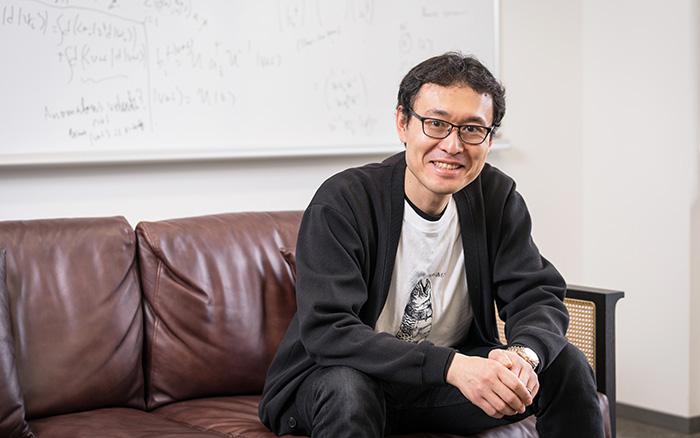
Dr. Tomoki Ozawa, the corresponding author of this research paper
In quantum mechanics, the geometry of quantum states has emerged as a powerful framework for understanding phenomena ranging from electrical conductivity to superconductivity. One research direction aims to extend these geometric concepts to non-Hermitian quantum mechanics—where systems can exchange energy with their environment—including the generalization of the Berry phase, a key geometric quantity, to the non-Hermitian case.
However, many geometric properties unique to non-Hermitian quantum mechanics remain poorly understood.
“We knew geometry played a central role in ordinary quantum mechanics, but what genuinely new geometric effects might emerge in the non-Hermitian case was far from clear,” explains Tomoki Ozawa, a theoretical physicist at AIMR. “We wanted to identify geometric phenomena that are truly intrinsic to non-Hermitian quantum mechanics.”
In a 2025 article, Ozawa and his collaborator Henning Schomerus, a professor at Lancaster University, used non-Hermitian Berry phase theory to investigate the geometric contribution to adiabatic amplification (i.e., the buildup of signal intensity as system parameters are slowly varied), identifying the conditions under which the amplification becomes path-independent1—a result with no counterpart in ordinary quantum mechanics.
The novelty of this approach lies in connecting two previously unrelated concepts in non-Hermitian physics. By showing that the Petermann factor—a static geometric property characterizing the non-orthogonality of a system’s eigenstates—directly governs the geometric contribution to adiabatic amplification, the team established a unified framework that had not previously existed.
“When the system possesses certain symmetries, such as reciprocity, where signals propagate symmetrically in opposite directions, the amplification becomes path-independent and depends solely on the ratio of the Petermann factors at the start and end points,” says Ozawa. “We confirmed this prediction through numerical simulations of two physically realistic models.”
The results not only demonstrated how the Petermann factor governs dynamical behavior under adiabatic conditions, but also offered a practical route to measuring this fundamentally important yet experimentally challenging quantity directly through amplification behavior.
Looking ahead, the team aims to extend their framework to more complex parameter spaces and to non-adiabatic processes involving non-Hermitian topological phase transitions—opening further avenues toward a deeper understanding of geometry in non-Hermitian quantum mechanics.
This project was unique in how it came together. When Prof. Schomerus arrived at AIMR through the GI3 program, we had only a vague idea of what we wanted to work on. We knew we wanted to explore something in non-Hermitian physics, but the project wasn’t concrete. As we discussed our ideas almost every day, the project emerged naturally and spontaneously. Within two months, we had our main results and had begun writing. Prof. Schomerus arrived in July 2024, left in August, and we submitted the paper in September. It reminded me how important it is for researchers to work in close physical proximity and discuss regularly.
(Author: Patrick Han)
This research highlight has been approved by the authors of the original article and all information and data contained within has been provided by said authors.

 Research Highlights