



March 23, 2026
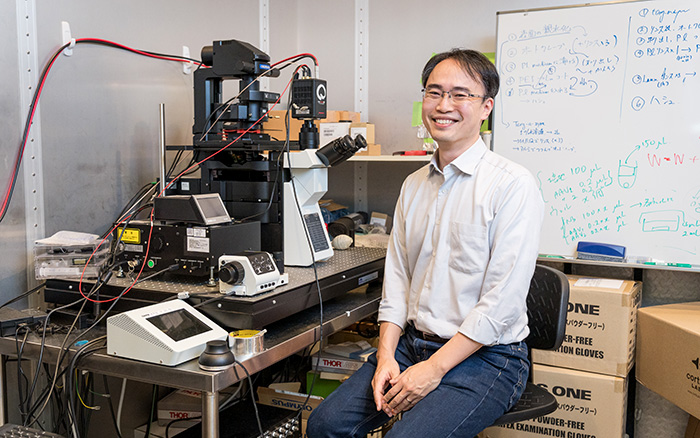
Dr. Hideaki Yamamoto, the corresponding author of this research paper
The brain is not a random collection of neurons. Across species, evolution has preserved key hierarchical architectural features, including modular organization, characterized by patches of densely clustered neurons, and directional wiring shaped by axon-to-dendrite signaling. How these structural features shape patterns of activity across neural networks remains an open question.
To this end, a standing question in neuroscience has been how these structural features shape collective neural dynamics. Specifically, how modular organization and directional connectivity influence the balance between globally synchronized activity and locally specialized, independent patterns across a network.
However, answering this question has been technically challenging.
“In conventional in vitro neuronal cultures, neurons tend to form largely homogeneous and highly reciprocal connections, often leading to excessive network-wide synchrony that masks the distinct roles of modular structure and directional connectivity,” says Hideaki Yamamoto, a researcher at AIMR. “When activity becomes globally synchronized, it is difficult to determine whether the dynamics reflect modular architecture or simply strong overall coupling.”
In a 2025 article, Yamamoto and co-workers addressed this challenge by integrating in vitro experiments with computational and mathematical modeling1.
“Experimentally, we used microfabricated devices to guide axonal growth and construct hierarchically modular networks with defined directional coupling between modules,” explains Yamamoto. “In parallel, we used spiking neural network (SNN) simulations and state-transition mathematical models to provide a framework for predicting how such architectures would regulate global synchrony. This combined experimental–theoretical approach enabled us to isolate the effects of network structure on collective neural dynamics.”
The key innovation of this work was the use of microfluidic devices containing asymmetrically tapered microchannels that bias axonal growth in a preferred direction. This geometry reinforces axon-to-dendrite connectivity between modules, favoring feedforward signaling across the network—an architecture not attainable in conventional cultures.
The in vitro experiments demonstrated that, rather than the uniform network-wide activation observed in conventional cultures, activity in the engineered networks propagated directionally between modules, producing more spatially segregated dynamics. Moreover, the SNN simulations and state-transition models not only reproduced these experimental observations but also enabled analytical predictions of how network topology shapes dynamics.
“Our work shows that the brain's hierarchical and directional architecture isn't arbitrary—these features actively regulate the balance between integrated and segregated activity patterns that makes complex behavior possible,” explains Yamamoto. “The new in vitro platform now enables us to apply these principles both in pharmacological research for drug discovery and as a foundation for brain-inspired biocomputing systems.”
My greatest sense of accomplishment came from demonstrating that directional connectivity and modular structure successfully suppress excessive synchrony in cultured neuronal networks—mirroring their role in the brain. This showed that brain-like architectures produce biologically grounded dynamics even in vitro. What surprised me most was discovering the power of integrating multiple disciplines—biology, physics, engineering, and mathematics. By bridging experiment and theory, we extracted universal principles governing network dynamics. Combining in vitro experiments, computational spiking neural network models, and mathematical state-transition models allowed us not just to observe phenomena but to understand and predict the underlying mechanisms analytically.
(Author: Patrick Han)
This research highlight has been approved by the authors of the original article and all information and data contained within has been provided by said authors.

 Research Highlights