



The modern world runs on invisible energy. Hidden inside smartphones, laptops, and electric vehicles, are batteries that quietly power everyday life. As society becomes increasingly dependent on portable and sustainable energy, the development of compact and reliable battery technology has become one of the most important technological challenges of our time.
Lithium-ion batteries currently dominate the battery industry, but alternatives that could offer improved safety, lower cost, and higher energy density are being actively explored. Solid-state magnesium batteries have long been considered a promising next-generation energy technology. However, instability inside these batteries remains a major obstacle to their development.
To confront these challenges, a research team from Tohoku University has developed a new way to improve solid-state magnesium batteries. While interfacial reactions between the solid electrolyte and electrode are usually considered harmful because they degrade battery performance over time, the researchers found that in solid-state magnesium batteries they are actually essential for improving battery efficiency — as long as the reactions are carefully controlled.
“For a long time, interfacial reactions were treated as something to avoid,” said Hao Li, Distinguished Professor at Tohoku University’s Advanced Institute for Materials Research (WPI-AIMR), “But our results show that when these reactions are carefully guided rather than suppressed, they can help solid-state magnesium batteries perform far more effectively.”
In their study, the researchers developed a new strategy for magnesium alloy anodes that balances these interfacial reactions. By engineering the surface and internal structure of the anode, they enabled magnesium ions to move more efficiently through the battery while improving overall stability and creating a more uniform magnesium deposition layer.
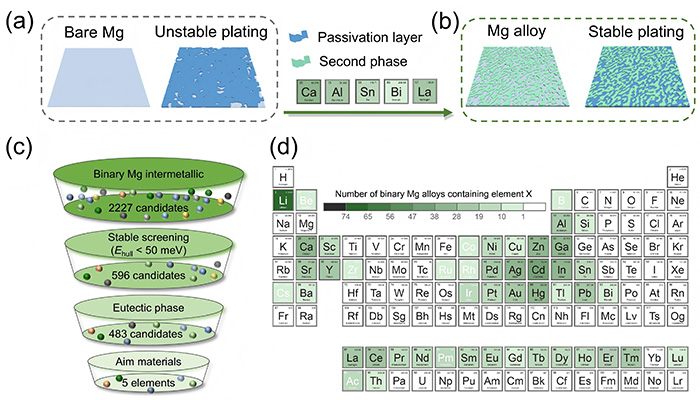
High-throughput analysis. Schematic illustration of the plating/stripping behavior of bare Mg (a) and Mg alloys (b). (c) Workflow for high-throughput screening of Mg binary compounds. (d) Number of Mg binary compounds formed with element X in the Materials Project database. Green boxes indicate systems with larger numbers of stable intermetallic phases, while white boxes indicate systems unable to form a stable second phase. ©Qian Wang et al.
The researchers focused on adding tin (Sn) to magnesium (Mg), since together they form a stable material called Mg2Sn—a phase that helps regulate reactions inside the battery. To identify the most effective composition, the team tested several magnesium-based alloys containing different secondary phases and evaluated their electrochemical performance under battery operating conditions. Among the tested materials, the optimized magnesium–tin alloy demonstrated the best balance between interfacial stability, magnesium-ion transport, and long-term cycling performance.
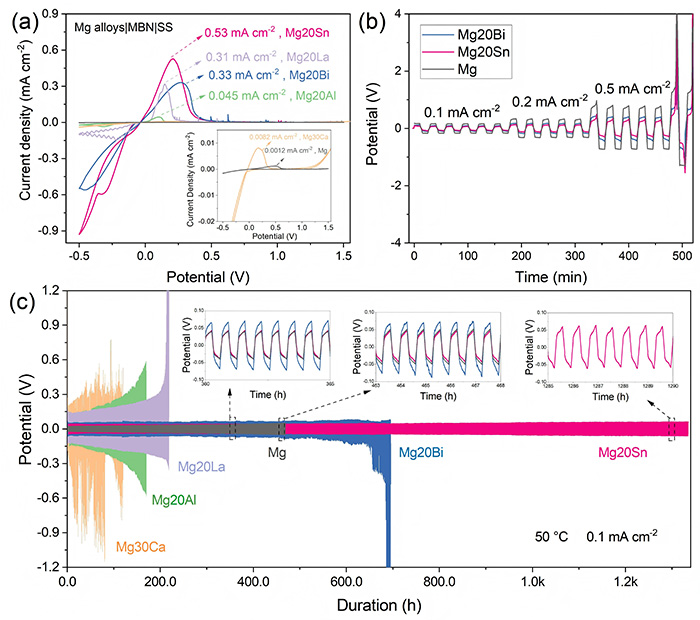
Electrochemical performance of Mg and Mg alloy anodes with MBN. (a) Cyclic voltammetry curves of Mg and Mg alloy|MBN|SS asymmetric cells. (b) Galvanostatic cycling of symmetric cells at current densities from 0.1 to 1 mA cm−2. (c) Long-term cycling curves of Mg and five alloy anodes with MBN in symmetric cells at 0.1 mA cm−2. Insets show detailed stripping/plating voltage plateaus at selected durations. ©Qian Wang et al.
The optimized magnesium–tin alloy demonstrated significantly improved electrochemical performance, including more stable cycling behavior and enhanced magnesium-ion transport at the electrode–electrolyte interface. In solid-state battery tests, the Mg–Sn alloy remained stable for over 1300 hours and achieved more than 400 times longer cycling performance than pure magnesium.
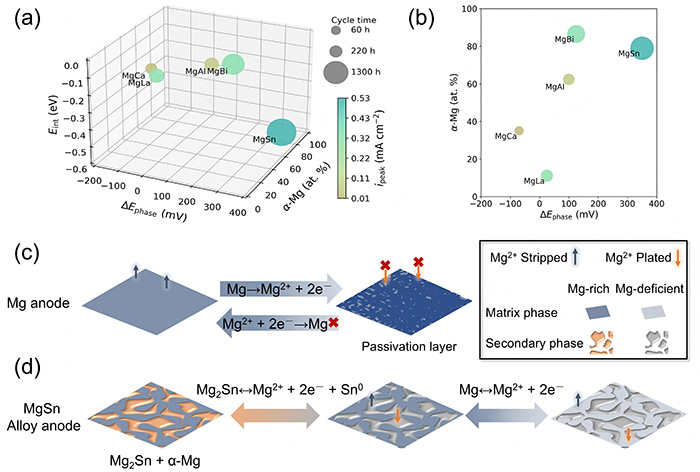
(a) Correlation among ΔEphase, α-Mg fraction, Eint, ipeak, and cycle time for Mg-based alloy anodes. Bubble size represents cycle time, while color reflects ipeak. (b) Top-view projection of the correlation map shown in (a). Schematic illustrations of SEI evolution and Mg deposition behavior for the Mg anode (c) and Mg20Sn alloy anode (d). ©Qian Wang et al.
For years, interfacial reactions inside solid-state magnesium batteries were seen as a major challenge limiting their performance. However, the researchers’ findings suggest that, when carefully controlled, these same reactions could become part of the solution. The study highlights the importance of balancing chemical reactions and ion transport together when designing battery interfaces. By turning one of the field’s biggest challenges into a functional advantage, the study opens a new direction for designing longer-lasting energy storage systems.
| Title: | Balancing Reactivity and Ion Transport in Mg Alloy Anodes via Secondary-Phase Engineering |
|---|---|
| Authors: | Qian Wang, Xue Jia, Ting Xu, Jianwei Li, Yungui Chen, Hao Li, Yigang Yan |
| Journal: | ACS Energy Letters |
| DOI: | 10.1021/acsenergylett.6c00909 |
Hao Li (Profile of Prof. Li)
Advanced Institute for Materials Research (WPI-AIMR), Tohoku University
| E-mail: | li.hao.b8@tohoku.ac.jp |
|---|---|
| Webstie: | Hao Li Laboratory |