

Hydrogen’s ability to power a cleaner future hinges not only on finding materials capable of efficiently storing and releasing it, but also on understanding the trade-off between storage capacity and practical operating conditions.
A research team led by Tohoku University, in collaboration with the University of Tokyo, developed the Digital Hydrogen Platform (DigHyd), a curated database containing more than 30,000 data entries from over 4,000 experimental publications. Using this resource, the team created a physical map linking material properties to hydrogen storage capacity and equilibrium pressure, which helps determine the conditions under which materials absorb and release hydrogen.
“Understanding hydrogen storage requires more than finding materials that can hold large amounts of hydrogen. We need to understand why their properties determine how hydrogen is retained and released. By combining reliable experimental data with interpretable AI, we can begin to uncover these underlying physical relationships,” says Hao Li, Distinguished Professor at the Advanced Institute for Materials Research (WPI-AIMR), Tohoku University.
Building a reliable database required more than automated data collection. The team combined AI-assisted literature mining with careful human validation, checking extracted information against original publications, standardizing units and analyzing experimental curves. For metal hydrides, materials that store hydrogen within their structures, the researchers manually curated 4,643 storage-capacity measurements and 652 pairs of enthalpy and entropy measurements. These thermodynamic quantities help predict how hydrogen storage behavior changes with temperature, while links to the original publications allow the data to be traced and verified.
The researchers then applied GoodRegressor, an AI method called symbolic regression that identifies relationships in data and expresses them as mathematical equations. In five-fold cross-validation tests, the method achieved predictive performance comparable to leading black-box models while producing equations that scientists could interpret. This allowed the team to move beyond predicting material behavior and investigate the physical mechanisms behind it.
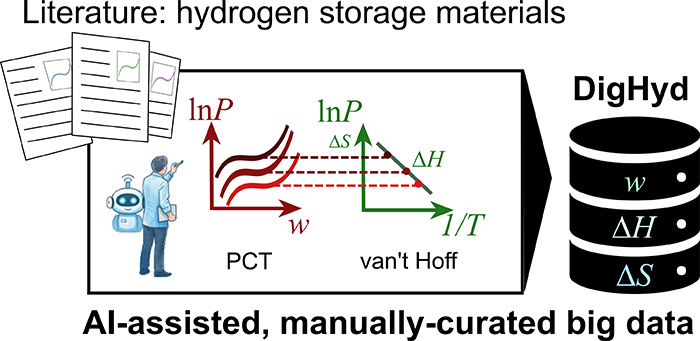
AI-assisted literature mining and human validation turn published pressure-composition-temperature (PCT) measurements and van’t Hoff analyses into curated hydrogen capacity, enthalpy and entropy data. These data support comparisons of storage behavior under different operating conditions. ©Seong-Hoon Jang et al.
The resulting map revealed an interconnected hierarchy of material properties that influence hydrogen storage capacity and equilibrium pressure. Lighter host atoms generally favor greater hydrogen storage capacity by weight. In interstitial hydrides, hydrogen occupies spaces between metal atoms, making atomic size and the arrangement of atoms in the crystal lattice important. Properties such as thermal expansion and thermal conductivity also provide clues to how a material accommodates hydrogen.
The map further showed how the mechanical properties of a material can affect hydrogen storage. When hydrogen enters a metal lattice, the structure must deform and expand. Stiffer materials resist this deformation, increasing the elastic energy required to accommodate hydrogen. This can make the hydride less stable and raise its equilibrium pressure. The team also identified connections between electronegativity, thermal conductivity and resistance to compression among the metals examined, helping explain why improving storage capacity can also change the conditions needed to release hydrogen.
These findings suggest that hydrogen storage capacity and equilibrium pressure should be considered together when designing new materials. Rather than treating each material property in isolation, the physical map provides a framework for understanding how several properties interact to shape storage performance. It also demonstrates how symbolic regression can uncover previously unrecognized physical relationships in experimental data.
“The important next step is to use these insights to guide the development of new materials and test whether their predicted properties hold up in experiments. By connecting data-driven analysis with the synthesis and evaluation of andidate materials, we hope to accelerate the search for practical hydrogen storage solutions,” says Shin-ichi Orimo of the Advanced Institute for Materials Research (WPI-AIMR), Tohoku University.
The team plans to expand and refine the database, identify promising material compositions and synthesize candidates for experimental testing. Comparing measured hydrogen storage behavior with model predictions will help refine the approach and guide the discovery of more effective storage materials. The DigHyd platform is publicly available at https://www.dighyd.org.
The study was published online in Applied Physics A on September 4, 2026.
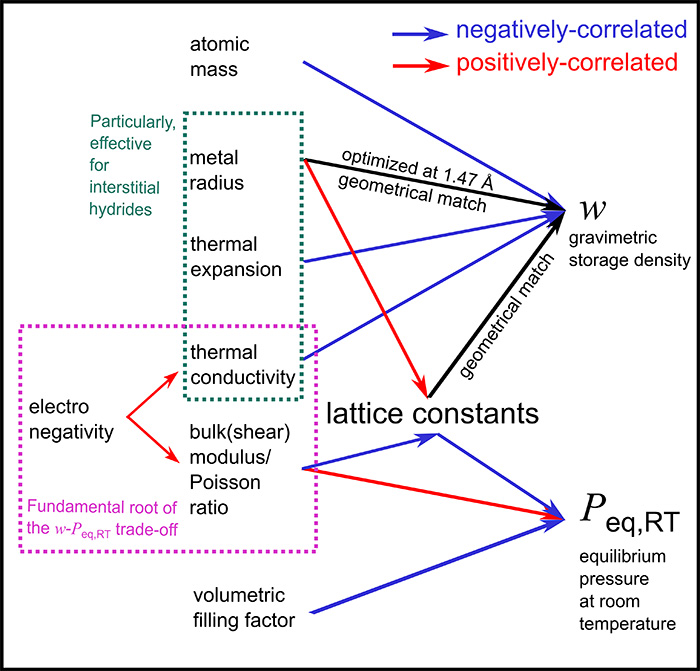
Physical map linking hydrogen storage capacity and equilibrium pressure. Atomic mass and lattice geometry help explain capacity, while resistance to lattice deformation influences equilibrium pressure. The green box highlights descriptors particularly relevant to interstitial hydrides. The magenta box links electronegativity, thermal conductivity and elastic stiffness, suggesting a physical basis for the capacity–pressure trade-off. Blue and red arrows indicate negative and positive contributions; black arrows indicate geometrical matching. ©Seong-Hoon Jang et al.
| Title: | Digital hydrogen platform (DigHyd): a rigorously curated database for hydrogen storage materials empowered by AI-assisted literature mining |
|---|---|
| Authors: | Seong-Hoon Jang, Di Zhang, Xue Jia, Hung Ba Tran, Linda Zhang, Ryuhei Sato, Yusuke Hashimoto, Toyoto Sato, Kiyoe Konno, Shin-ichi Orimo, and Hao Li |
| Journal: | Applied Physics A |
| DOI: | 10.1007/s00339-026-09903-6 |
Hao Li (Profile)
Advanced Institute for Materials Research (WPI-AIMR), Tohoku University
| E-mail: | li.hao.b8@tohoku.ac.jp |
|---|---|
| Website: | Hao Li Laboratory |
Shin-ichi Orimo (Profile)
Advanced Institute for Materials Research (WPI-AIMR), Tohoku University
| E-mail: | shin-ichi.orimo.a6@tohoku.ac.jp |
|---|---|
| Website: | Orimo Laboratory |
Seong-Hoon Jang
Unprecedented-scale Data Analytics Center, Tohoku University
| E-mail: | jang.seonghoon.b4@tohoku.ac.jp |
|---|---|
| Website: | Tohoku University Researchers |