


What if the blue pigment in your ink or dye could help power the future of clean energy? A recent study has shown that this may be a future possibility.
A research team led by Professor Hiroshi Yabu at Tohoku University’s Advanced Institute for Materials Research and Professor Dario R. Dekel at the Technion (Israel Institute of Technology), working with Professor Yasutaka Matsuo at Hokkaido University and AZUL Energy, Inc., has developed carbon-supported blue-pigment catalysts for anion-exchange membrane fuel cells. By optimizing the pigments’ molecular structures, the team achieved a power density that exceeds 900 milliwatts per square centimeter, the highest performance with these materials reported to date, all without relying on platinum.
“This work shows that careful molecular design can close the performance gap between platinum catalysts and platinum-free catalysts,” said Yabu. “By tuning the structure of these blue pigment molecules, we were able to strengthen the interaction at the active site and translate that into real gains in fuel cell performance.”
Fuel-cell cathodes commonly use platinum nanoparticles supported on carbon because platinum efficiently catalyzes the oxygen reduction reaction. Platinum is extremely costly and subject to many resource constraints. Anion-exchange membrane fuel cells (AEMFCs) operate under mild alkaline conditions and can more readily employ platinum-free catalysts. Metal phthalocyanines, blue pigments built around a metal complex, are inexpensive, structurally tunable candidates, but previous molecular catalysts have generally provided insufficient power and limited durability in complete AEMFC devices.
The team synthesized two iron tetra-azaphthalocyanines in which nitrogen-containing heterocycles replace the peripheral benzene rings of conventional iron phthalocyanine. FeAzPc-4N supported on conductive Ketjen Black carbon was designated AZ-FT-30, while the more nitrogen-rich FeAzPc-8N8Me material was designated AZ-FO-30. Electron microscopy and elemental analysis confirmed that the iron-containing molecules were dispersed at the atomic and molecular scale on the carbon without forming larger particles.
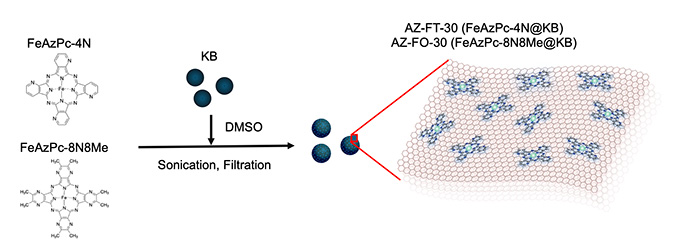
Schematic illustration of chemical structures of catalysts and preparation method of catalysts on carbons. ©Hiroshi Yabu and Dario R. Dekel
Because the two catalysts had nearly identical electrochemical surface areas (155.8 and 157.5 square meters per gram), the researchers could attribute the performance difference mainly to the molecules’ intrinsic properties. In AEMFC tests at 80 degrees Celsius, AZ-FT-30 reached a peak power density of 744 milliwatts per square centimeter, while AZ-FO-30 reached 902 milliwatts per square centimeter. The manuscript reports this as the highest power density recorded for an AEMFC cathode based on a metal phthalocyanine. AZ-FO-30 also operated for 35 hours at a high constant load of 400 milliamperes per square centimeter, with an average decay rate of only 2.4 millivolts per hour.
Density functional theory calculations, performed by Professor Maytal Caspary Toroker and her team at Technion, linked the improved cell performance to molecular-scale oxygen binding. For adsorbed OH, the iron-oxygen distance decreased in the order pristine iron phthalocyanine, AZ-FT-30, and AZ-FO-30. The shortest distance in AZ-FO-30 indicates the strongest interaction at the iron active site among the three. The same trend persisted when an explicit water molecule was included in the model, strengthening the link between molecular design and experimentally observed activity.
Details of the study were published in the journal ACS Catalysis on September 26, 2026.
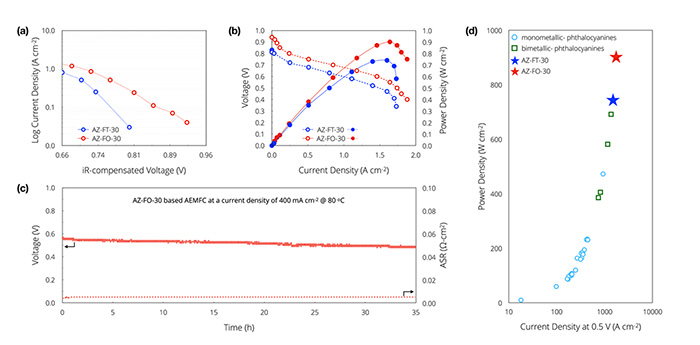
I-V curves (a), Polarization curves (empty symbols, Y1 axis) and power density curves (closed symbols, Y2 axis) as a function of current density (b), short-term durability test of the AZ-FO-30 AEMFC as a function of time at a constant current density of 400 mA-2 (c) and performance comparison of our AEMFCs with other MPc-based cathode AEMFCs in the literature (d). ©Hiroshi Yabu and Dario R. Dekel
| Title: | Advanced Metal-Phthalocyanine-based Catalysts with Enhanced Oxygen Reduction Reaction Activity for High-Performance Anion-Exchange Membrane Fuel Cells |
|---|---|
| Authors: | John C. Douglin, Kosuke Ishibashi, Yutaro Hirai, Yasutaka Matsuo, Koji Suto, Pankaj Kumar, Maytal Caspary Toroker, Hiroshi Yabu, Dario R. Dekel |
| Journal: | ACS Catalysis |
| DOI: | 10.1021/acscatal.6c03312 |
Hiroshi Yabu (Profile)
Advanced Institute for Materials Research (WPI-AIMR), Tohoku University
| E-mail: | hiroshi.yabu.d5@tohoku.ac.jp |
|---|---|
| Website: | Hiroshi Yabu Laboratory |