



A research team at Tohoku University and Future University Hakodate has demonstrated that living biological neurons can be trained to perform a supervised temporal pattern learning task previously carried out by artificial systems. By integrating cultured neuronal networks into a machine learning framework, the team showed that these biological systems can generate complex time-series signals, marking a significant step forward in both neuroscience and bio-inspired computing.
The study was published online in Proceedings of the National Academy of Sciences (PNAS) on March 12, 2026, highlighting a novel intersection between living neural systems and computational technology. The findings suggest that biological neural networks (BNNs) may serve as viable alternatives or complements to existing machine learning models.
Artificial neural networks (ANNs) and spiking neural networks (SNNs) have long been used in machine learning and neuromorphic hardware. A framework known as reservoir computing has emerged as an efficient approach for processing time-dependent data by leveraging the dynamic properties of recurrently connected ANNs and SNNs.
In conventional ANN-based reservoir computing, methods such as First-Order Reduced and Controlled Error (FORCE) learning enable real-time adaptation by continuously adjusting output signals in response to errors. These techniques allow artificial systems to generate a wide range of temporal patterns, including periodic and chaotic signals. However, whether similar approaches could be applied to biological neural networks has remained an open question.
To address this gap, the researchers constructed biological neural networks using cultured rat cortical neurons and incorporated them into a reservoir computing framework. By applying FORCE learning to optimize the system’s readout layer, the team successfully trained the biological networks to produce complex temporal signals comparable to those involved in motor control.
A key innovation in the study was the use of microfluidic devices to precisely guide neuronal growth and control network connectivity. This approach enabled the researchers to create modular network architectures that minimized excessive synchronization, thereby promoting the rich, high-dimensional dynamics required for effective reservoir computing.
Using this system, the BNN-based framework was able to generate a variety of time-series patterns, including sine waves, triangular waves, square waves, and even chaotic trajectories such as the Lorenz attractor. Notably, the network demonstrated flexibility by learning and stably reproducing sine waves with periods ranging from 4 to 30 seconds within the same system.
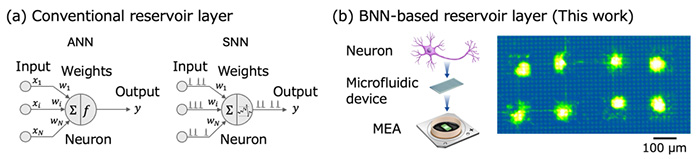
(a) Conventional neuron models used in reservoir computing. Artificial neural networks (ANNs) comprise of neuron models that sum up weighted inputs, filter the value through an activation function, and generate a continuous valued output. Spiking neural networks (SNNs) comprise of neuron models receive spiking inputs and output spikes when their membrane potential exceeds a threshold. (b) Biological neurons used for reservoir computing in this work. Rat cortical neurons are cultured in microfluidic devices that are attached to a microelectrode array. ©Yuki Sono et al.
“This work shows that living neuronal networks are not only biologically meaningful systems but may also serve as novel computational resources,” said Hideaki Yamamoto, a professor at Tohoku University. “By bridging neuroscience and machine learning, we are opening a pathway toward new forms of computing that leverage the intrinsic dynamics of biological systems.”
Looking ahead, the research team aims to improve the stability of signal generation after training has concluded. Future efforts will focus on reducing feedback delays and refining the FORCE learning algorithm. In parallel, the platform may be expanded into a microphysiological system for studying drug responses and modeling neurological disorders, further extending its impact across both scientific and medical fields.
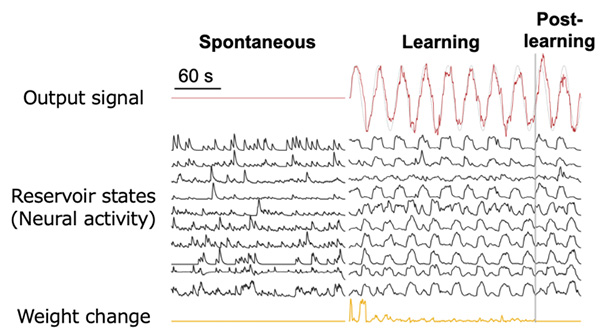
Example of time-series learning using physical reservoir computing with cultured neurons. A 30-second-period sine wave was provided as the target signal. In the absence of input, the BNN exhibits high-dimensional, complex activity; with FORCE learning and feedback, the activity becomes structured and reproduces the target waveform. Under suitable conditions, the network continues to autonomously generate trained signals even after the learning is stopped. ©Yuki Sono et al.
| Title: | Online supervised learning of temporal patterns in biological neural networks under feedback control |
|---|---|
| Authors: | Yuki Sono, Hideaki Yamamoto, Yusei Nishi, Takuma Sumi, Yuya Sato, Ayumi Hirano-Iwata, Yuichi Katori, Shigeo Sato |
| Journal: | Proceedings of the National Academy of Sciences |
| DOI: | 10.1073/pnas.2521560123 |
Hideaki Yamamoto (Profile of Dr. Yamamoto)
Research Institute of Electrical Communication, Tohoku University
| E-mail: | hideaki.yamamoto.e3@tohoku.ac.jp |
|---|