



A research team has discovered a new way to control tiny magnetic properties inside materials using electric current, which could possibly pave the way for new types of computing technologies.
The work is based on spintronics, a field that uses not only the electric charge of electrons but also their “spin,” a quantum property that can be thought of as a tiny magnet. Spintronics is already used in magnetic random access memory (MRAM), a type of memory that keeps data even when the power is turned off. This is different from conventional memory, which loses information without electricity.
In MRAM, data is stored depending on whether spins point “up” or “down.” These two stable states are separated by an energy barrier, which helps keep the data secure. However, this stability also makes it harder to switch between states, requiring strong electric currents.
To overcome this limitation, the researchers took a different approach. Instead of making spins strongly prefer one direction, they created a material where spins can point equally in any direction. This was achieved by carefully designing a thin film made of tungsten, cobalt iron boron, and magnesium oxide, and adjusting its heat treatment to balance competing effects.
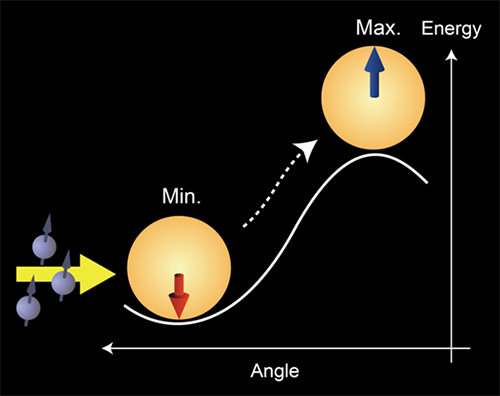
An image of the dynamical stability of spin under the spin transfer torque. ©Takeshi Seki et al.
When an electric current was applied to this material, the team observed a surprising effect. The spins settled into a normally unstable state—similar to balancing a ball at the top of a hill rather than letting it roll down. At the same time, the spins showed large fluctuations, meaning they moved around more freely than in conventional materials.
“These results show that electric current can actively stabilize spins in energetically unfavorable states, something that was previously thought to be difficult to achieve,” said Takeshi Seki from Tohoku University’s Institute for Materials Research. “By harnessing these large fluctuations, we may be able to develop new types of computing that go beyond simple ones and zeros.”
This behavior opens the door to a different style of computing. Instead of using only binary values (0 and 1), the fluctuating spins can act like continuous values, offering more flexibility. The researchers tested this idea using a machine learning model known as a restricted Boltzmann machine and found that it performed better when using these continuous signals.
Because the materials used in this study are already common in existing MRAM technology, the findings could be applied relatively quickly. The team hopes that integrating this approach into future devices will help create more efficient and powerful computing systems for applications such as artificial intelligence and the Internet of Things.
Details of the study were published in the journal Nature Materials on March 4, 2026.
| Title: | Dynamical stability by spin transfer in nearly isotropic magnets |
|---|---|
| Authors: | Hidekazu Kurebayashi, Joseph Barker, Takumi Yamazaki, Varun K. Kushwaha, Kilian D. Stenning, Harry Youel, Xueyao Hou, Troy Dion, Daniel Prestwood, Gerrit E. W. Bauer, Kei Yamamoto, and Takeshi Seki |
| Journal: | Nature Materials |
| DOI: | 10.1038/s41563-026-02510-z |
Takeshi Seki
Institute for Materials Research, Tohoku University
| E-mail: | takeshi.seki@tohoku.ac.jp |
|---|---|
| Webstie: | Seki Lab (Magnetic Materials) |