
October 26, 2026

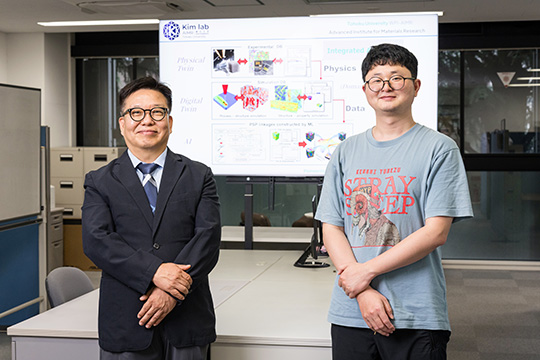
Dr. Renhao Wu (left) and Dr. Hyoung Seop Kim, the corresponding authors of this review paper
Designing structural high-entropy alloys (SHEAs) means solving a problem with an enormous number of moving parts: which combinations of composition and processing conditions will yield the phases, microstructures, and mechanical properties a given application demands? Because these alloys mix multiple principal elements in comparable proportions, that question spans length and time scales that no single experiment or model can cover on its own.
To this end, researchers have built computational tools to address individual aspects of this problem. However, no unified approach connected these aspects, spanning from atomic-scale interactions and phase stability to microstructure and the macroscopic properties. Each method also carries its own tradeoffs in scale, cost, and predictive accuracy.
In a 2026 review, an international research team—led by researchers at AIMR and POSTECH—brings these fragmented approaches together into a more systematic framework for SHEA development, tracing how composition, processing, microstructure, and properties shape one another1.
The review’s organizing insight is to treat computational methods as complementary tools operating at different scales—density functional theory and molecular dynamics at the atomic scale, calculation of phase diagrams and phase-field modeling at the level of phase stability and microstructure evolution, and crystal plasticity modeling bridging microstructure to mechanical behavior—with artificial intelligence (AI) and machine learning extending the analysis into data-driven design.
“Read together, a composite picture emerges from the reviewed work,” explains Hyoung Seop Kim, the corresponding author of the review. “Aspects including phase stability, microstructure evolution, and mechanical properties can now be predicted coherently, rather than piecemeal.”
The review also shows how simulating manufacturing processes—additive manufacturing and severe plastic deformation among them—can link processing conditions directly to microstructural outcomes and performance. Related studies further demonstrate how processing-guided microstructural design can be used to create integral core–shell architectures and reverse-gradient structures for enhanced mechanical performance and resistance to hydrogen embrittlement2,3,4,5. Together, these findings sketch a path for SHEA development to move past empirical trial and error toward more systematic, predictive design.
Looking ahead, the authors envision a closed-loop platform: computation and AI flag promising compositions, physics-based simulations explain the mechanisms behind them, and experiments validate and feed data back into the models.
What gave me the greatest sense of accomplishment was not simply collecting existing studies, but organizing a rapidly expanding field into a coherent design philosophy. High-entropy alloys are exciting precisely because they abandon the idea that an alloy needs one dominant element—though that freedom also brings real complexity, since composition, processing, microstructure, and deformation are all tightly coupled. Through this review, I wanted to show that future alloy development cannot rely on intuition alone; computational science, processing science, and artificial intelligence need to work together. For young researchers entering this field, my hope is that they learn to move freely between experiment, theory, computation, and data.
(Author: Patrick Han)
This research highlight has been approved by the authors of the original article and all information and data contained within has been provided by said authors.

 Research Highlights