

A battery material can look perfect in the lab and still fail in a real battery. That is the puzzle facing researchers working on solid electrolytes, the materials seen as key to safer, longer-lasting batteries.
For years, the race has focused on one number: how quickly ions move through the material. But speed alone is not enough. A practical solid electrolyte must also block electrons, stay chemically stable, withstand mechanical stress, be easy to manufacture, and work smoothly with the battery’s electrodes.
An international team led by Associate Professor Eric Jianfeng Cheng and Professor Hao Li of Tohoku University’s Advanced Institute for Materials Research (WPI-AIMR) has published an invited Perspective in Advanced Materials on how artificial intelligence (AI) could change this field.
Rather than using AI only to predict the properties of individual materials, the team proposes a connected research system. It links living databases that record how materials were made and tested, AI-powered simulations that follow ion movement over longer times and in more realistic systems, and large language models (LLMs) that turn information buried in papers, figures, and tables into organized knowledge. Automated experiments then test promising candidates quickly, while human expertise guides the whole process.
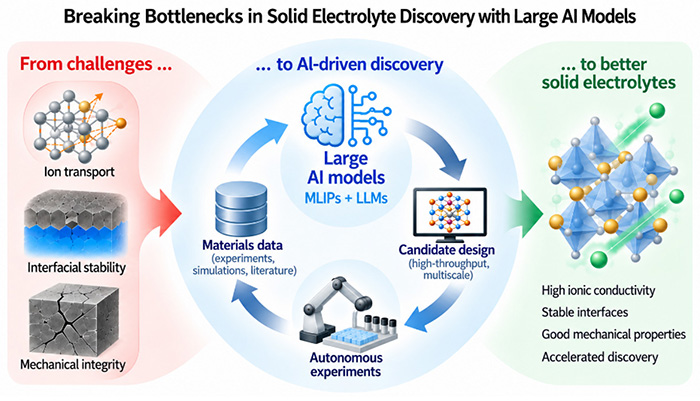
Large AI models are presented as a route to break key bottlenecks in solid electrolyte discovery by linking materials databases, machine‐learning interatomic potentials, large language models, and autonomous experiments. This perspective highlights how AI can accelerate the identification of solid electrolytes with fast ion transport, stable interfaces, and robust mechanical properties for better solid‐state batteries. ©Eric Jianfeng Cheng et al.
The ultimate goal is a “closed loop.” AI suggests candidates, physics-based models check them, experiments confirm the results, and the new data feed back into the AI for the next round.
“Finding a material with high ionic conductivity is only the first step,” says Professor Cheng. “The real challenge is to build a system where data, simulations, experiments, and researchers keep learning from one another, so that the materials we discover are not only fast, but also reliable and safe.”
The authors stress that this approach is meant to support scientists, not replace them. Researchers remain essential for asking the right questions, setting safety limits, understanding why materials behave as they do, and interpreting surprising results.
By connecting data, models, experiments, and human insight, the framework could shift solid-electrolyte research from scattered trial and error toward a more traceable, reproducible, and continuously improving process. The future competition may be less about who finds the fastest-conducting material first, and more about who builds the most trustworthy discovery system. Over time, this could help bring safer, longer-lasting batteries to electric vehicles, portable electronics, and large-scale energy storage.
Details were published in the journal Advanced Materials on October 13, 2026.
| Title: | Breaking Bottlenecks in Solid Electrolyte Discovery with Large Artificial Intelligence Models |
|---|---|
| Authors: | Eric Jianfeng Cheng, Min Hong, Zhiquan Zeng, Chuanyu Liu, Qian Wang, Melissa Jane Meadowcroft, Vlad Badilita, Carlos Miguel Costa, Senentxu Lanceros-Méndez, Ying Li, Chenyao Ma, Weibo Gong, Surendra Kumar Martha, Aloysius Soon, Piao Ma, Di Zhang, Teguh Ariyanto, Sudaryanto, Hiroshi Kakinuma, Jie Zhao, Jiayu Peng, Pengfei Ou, Jun Lu, Shin-ichi Orimo, Hao Li |
| Journal: | Advanced Materials |
| DOI: | 10.1002/adma.75354 |
Eric Jianfeng Cheng (Profile)
Core Research Cluster for Materials Science (CRC-MS), Tohoku University
Advanced Institute for Materials Research (WPI-AIMR), Tohoku University
| E-mail: | ericonium@tohoku.ac.jp |
|---|---|
| Website: | Cheng Group |
Hao Li (Profile)
Advanced Institute for Materials Research (WPI-AIMR), Tohoku University
| E-mail: | li.hao.b8@tohoku.ac.jp |
|---|---|
| Website: | Hao Li Laboratory |