

Polymer brushes are dense layers of polymer chains that can be engineered to change how a surface interacts with its surroundings. By controlling interactions with water, ions, proteins, and other materials, they can reduce friction, prevent unwanted materials from sticking, improve separation, and support the functionality of sensors and other devices. These capabilities make polymer brushes useful in a wide range of technologies such as coatings, lubrication, membranes, sensors, and nanoparticle-based systems.
However, predicting their performance can be difficult because many interacting factors can influence how polymer brushes behave. To address this challenge and improve the process of designing polymer brushes for different conditions and applications, the researchers introduce the idea of “interfacial intelligence.” This approach combines polymer physics, molecular simulations, machine learning, databases, and experiments into a framework for efficient polymer brush design.
The study was published in JACS Au on September 28, 2026.
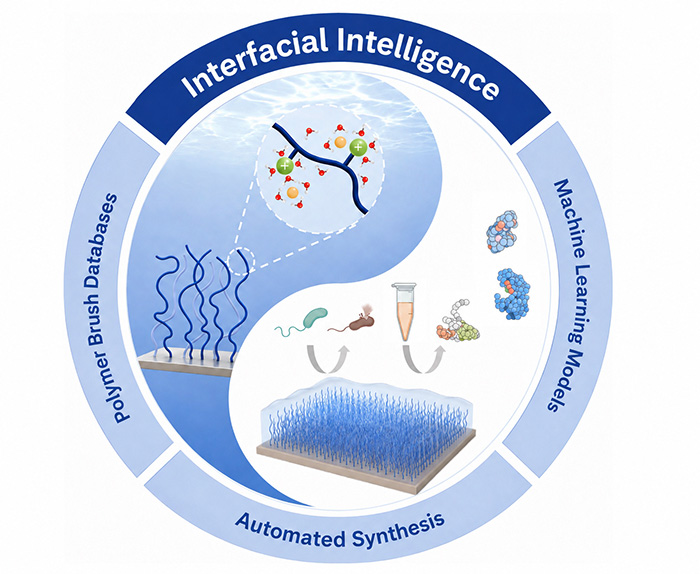
Concept of interfacial intelligence for polymer-brush design. ©Hao Li et al.
“A polymer brush is more than just its chemical composition. Even if two polymer brushes are made from similar materials, they can look and behave very differently depending on how their chains are arranged and the conditions around them,” said Distinguished Professor Hao Li of Tohoku University’s Advanced Institute for Materials Research (WPI-AIMR). “This is part of what makes design so challenging, and why we need alternate approaches.”
Once a polymer brush is in use, its behavior can also change with the conditions around it. Much like the bristles of a brush respond to pressure and the surface they touch, polymer brushes can respond to changes in their environment. Even subtle changes can alter their behavior, making performance depend on both their design and the conditions in which they are used.
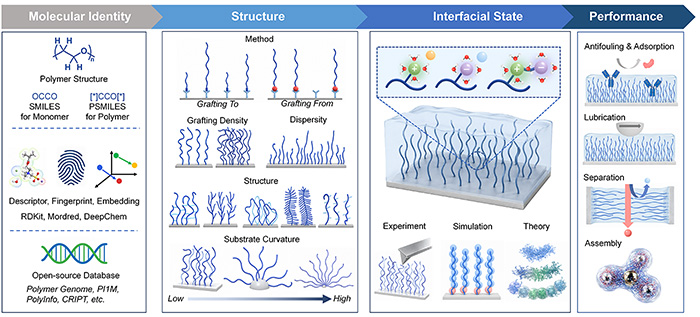
Multilevel representation of polymer brushes for physics-grounded learning. Molecular identity and brush structure determine the interfacial state, including hydration and ion organization, which ultimately governs material performance. ©Hao Li et al.
The framework proposed by the researchers is not simply an application of AI to polymer materials. Instead, it combines machine learning with physical models, simulations, and experimental data to produce predictions that can be physically interpreted and tested. The team also outlines their plan to eventually expand their framework so that it includes a closed-loop system in which databases, synthesis, characterization, and modeling continually inform one another. Experimental results can then be used to update the models, which could guide future material design and experiments.
“A useful model should not just tell us which polymer brush might work. It should predict how the interface will change under specific conditions, and what we should be able to measure if that prediction is correct,” said Hao Li.
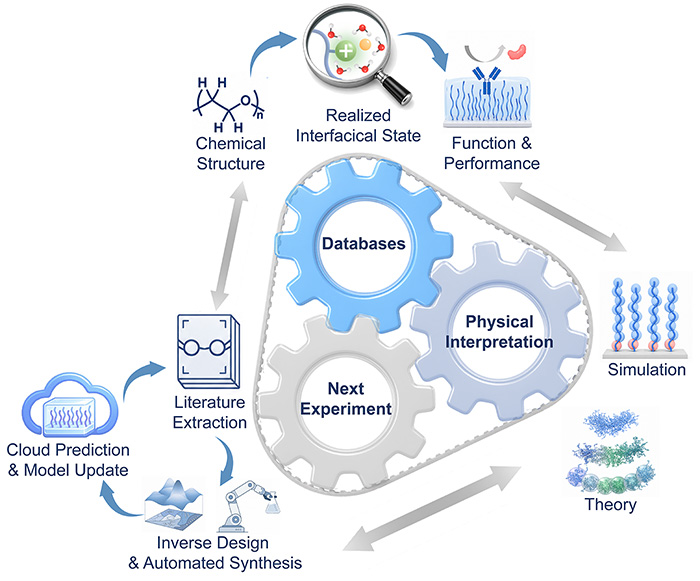
Roadmap toward closed-loop interfacial intelligence. Physics-based models, machine learning, molecular simulations, characterization, active learning, and automated synthesis are linked through experimentally measured interfacial states. ©Hao Li et al.
By linking design, interfacial state, and performance, the researchers hope to better understand why the same polymer brush can perform differently under different conditions. The proposed framework could help guide the development of more predictable and reliable polymer interfaces for a wide range of applications.
| Title: | Interfacial Intelligence for Polymer Brushes: Toward Physics-Grounded Design |
|---|---|
| Authors: | Jie Zhu, Xinran Zhao, Dong Wu, Sarah L. Perry, Hao Li, Xiayun Huang, Zhihong Nie |
| Journal: | JACS Au |
| DOI: | 10.1021/jacsau.6c01349 |
Hao Li (Profile)
Advanced Institute for Materials Research (WPI-AIMR), Tohoku University
| E-mail: | li.hao.b8@tohoku.ac.jp |
|---|---|
| Website: | Hao Li Laboratory |