



Artificial intelligence (AI) is increasingly being used to discover new materials, but conventional data-driven approaches can struggle to explain their predictions, work reliably beyond their training data and remain consistent with physical laws. A new Perspective proposes a framework called Physics-Grounded Materials AI (PhysMat AI), which integrates fundamental physical knowledge into the materials discovery process.
“Materials discovery cannot rely on correlations in data alone,” says Hao Li, Distinguished Professor at the Advanced Institute for Materials Research (WPI-AIMR) at Tohoku University. “By incorporating physical principles into AI, we can make its predictions more interpretable, testable and meaningful from a materials science perspective.”
The behavior of materials is governed by factors including thermodynamics, kinetics, electronic structure, transport processes and operating environments. The researchers argue that incorporating this knowledge into AI systems can help move materials discovery beyond correlation-based prediction toward reasoning based on physical principles.
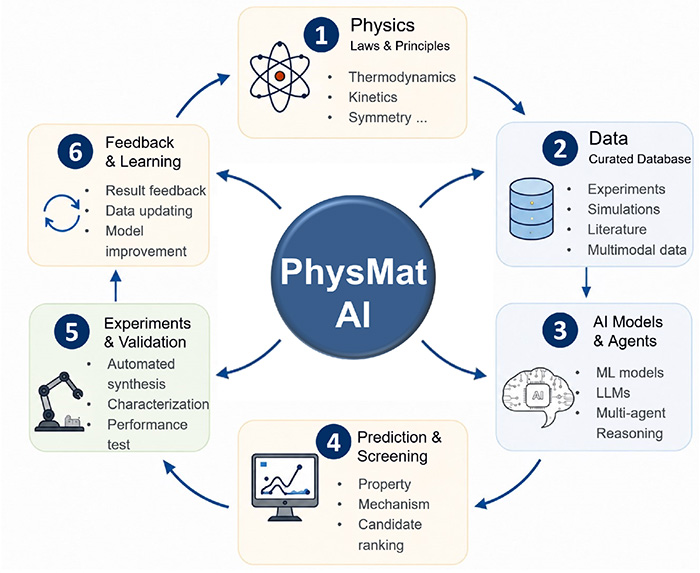
Overall closed-loop workflow of Physics-Grounded Materials AI (PhysMat AI). It describes a closed-loop materials-discovery workflow that integrates physical principles, curated databases, AI models and agents, prediction and screening, experimental validation, and continuous feedback. Physics provides the scientific foundation for data representation and model reasoning, while validated results are continuously fed back to improve both the knowledge base and AI models, enabling reliable, interpretable, and continuously evolving materials discovery. ©Hao Li et al.
The framework organizes physical knowledge into five complementary roles: prior knowledge, descriptors, constraints, verifiers and infrastructure. These roles can guide how materials data are represented, how AI models reason about potential materials and how their predictions are evaluated against physical principles.
The Perspective presents examples from catalysis, solid-state electrolytes for solid-state batteries and hydrogen-storage materials. In these areas, physical principles can help define meaningful search spaces, evaluate predicted materials and connect AI-generated predictions with mechanisms that can be tested experimentally.
The researchers also discuss how AI agents could combine these physics-aware components with scientific databases, simulations and experimental data. Such systems could help formulate hypotheses, select appropriate scientific tools and assess whether proposed materials are physically feasible.
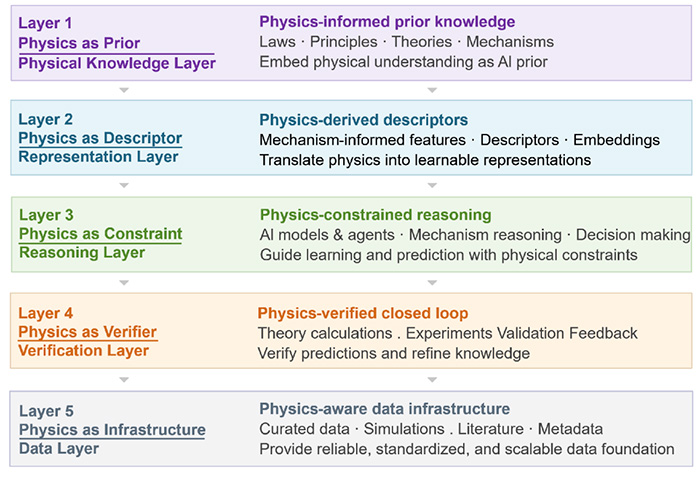
Five-layer physics architecture underlying PhysMat AI. The five-layer architecture illustrates how physical knowledge is systematically integrated into materials intelligence through prior knowledge, descriptors, constraints, verification, and infrastructure. These complementary layers span the complete AI workflow, from knowledge representation and physics-guided reasoning to validation and data infrastructure, providing a unified perspective for reliable, interpretable, and continuously evolving materials discovery. ©Hao Li et al.
The researchers propose a development pathway from physics-aware AI, which incorporates physical knowledge into AI systems, to physics-reasoning AI, which can use that knowledge during scientific reasoning, and eventually physics-autonomous AI, which could integrate physical reasoning, simulations and experiments in a continuous discovery process.
The framework provides a way to connect AI-based prediction with established principles of materials science. Further development could support materials discovery for energy technologies, including catalysts, solid-state batteries and hydrogen-storage materials, while helping make AI-generated predictions more interpretable and experimentally testable.
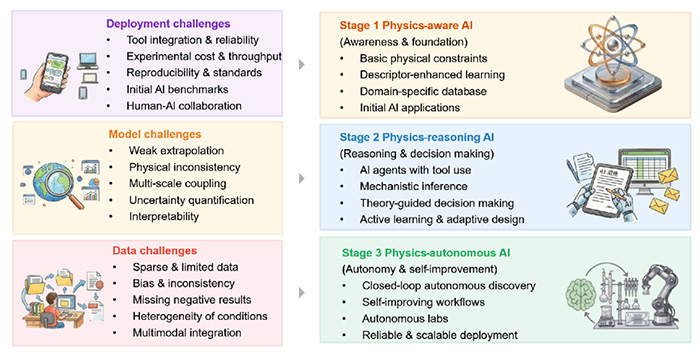
Challenges and roadmap of PhysMat AI. Key deployment, model, and data challenges facing PhysMat AI, together with a three-stage roadmap from physics-aware AI to physics-reasoning AI and ultimately physics-autonomous AI for reliable and autonomous materials discovery. ©Hao Li et al.
| Title: | Physics-Grounded Materials Artificial Intelligence for Reliable Materials Discovery |
|---|---|
| Authors: | Yuhang Wang, Qian Wang, Seong-Hoon Jang, Hao Li |
| Journal: | Advanced Functional Materials |
| DOI: | 10.1002/adfm.78119 |
Hao Li (Profile)
Advanced Institute for Materials Research (WPI-AIMR), Tohoku University
| E-mail: | li.hao.b8@tohoku.ac.jp |
|---|---|
| Website: | Hao Li Laboratory |