



A new electrochemical system simultaneously converts plant-derived materials and nitrate pollutants into valuable industrial chemicals. Developed by Tohoku University researchers, the system provides more sustainable way to manufacture chemicals while helping address wastewater pollution.
Details of the system were published in the journal Angewandte Chemie on June 8, 2026.
A new catalyst that enables two chemical reactions to occur efficiently within the same electrolysis device made the process possible. The system converts a biomass-derived compound called 1,5-pentanediol into glutaric acid, an important chemical used in the production of polymers and specialty materials, while also transforming nitrate contaminants in wastewater into ammonia, a key ingredient in fertilizers and many industrial products.
Traditional electrolysis systems typically use a reaction known as oxygen evolution at the anode. While necessary, this process consumes considerable energy and does not produce a useful product. The new approach replaces this reaction with the oxidation of 1,5-pentanediol, allowing the system to generate a valuable chemical while reducing energy consumption.
To achieve this, the researchers created a nickel-vanadium layered double hydroxide (NiV-LDH) catalyst containing specially engineered nickel-oxygen-vanadium bridges. These atomic-scale structures alter the electronic properties of the catalyst, allowing it to accelerate both chemical reactions occurring within the electrolysis cell.
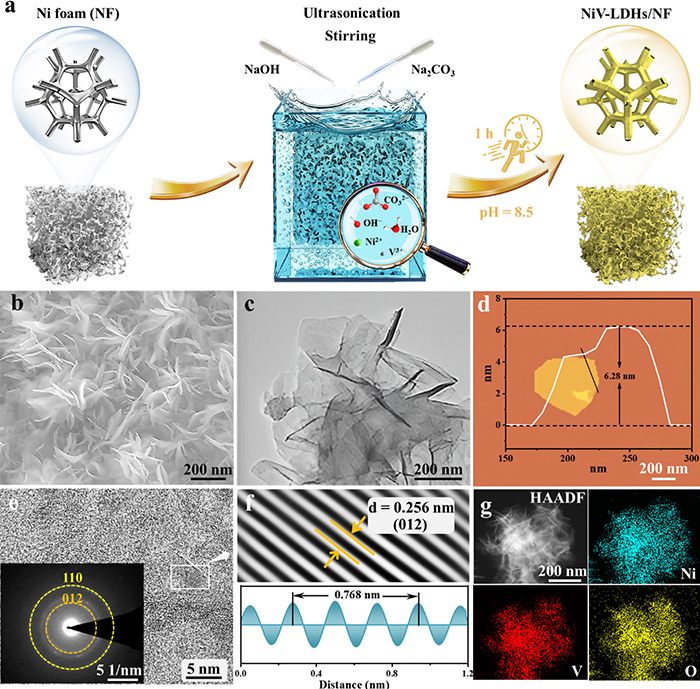
Morphology characterization of NiV-LDHs catalyst. (a) Schematic illustration for the synthesis process of NiV-LDHs electrode. (b) SEM, (c) TEM, (d) AFM, and (e) HRTEM images of NiV-LDHs catalyst (the embedded diffraction pattern is the corresponding SAED diagram). (f) Lattice view through fast Fourier transforms from the HRTEM image. (g) HAADF-STEM image and the corresponding EDS element mapping of NiV-LDHs catalyst. ©Bin Liu et al.
The new catalyst demonstrated exceptional performance. It converted 1,5-pentanediol into glutaric acid with a Faradaic efficiency of 98.5%, meaning nearly all of the electrical energy contributed to the desired product. At the same time, nitrate was converted into ammonia with a Faradaic efficiency of 96.1%, outperforming many previously reported catalysts.
Advanced experimental measurements and computer simulations revealed why the catalyst performs so well. The nickel-oxygen-vanadium bridges create strong electronic interactions between the nickel and vanadium atoms, optimizing how reaction molecules interact with the catalyst surface and enabling both reactions to proceed efficiently.
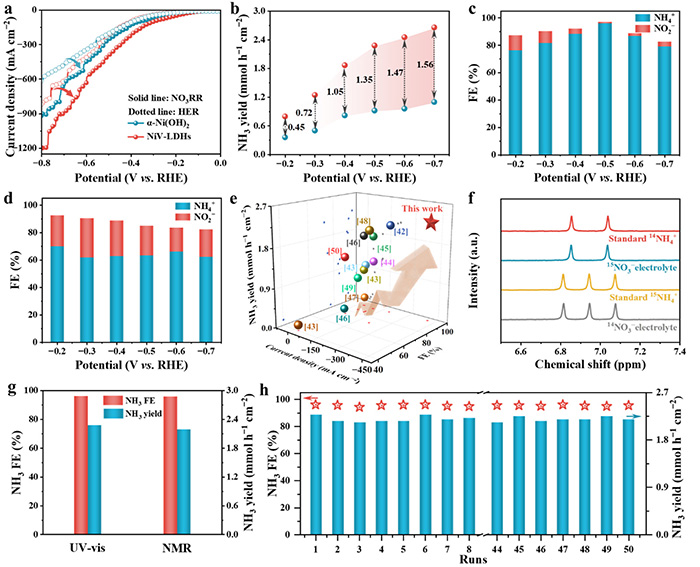
Electrochemical properties of NO3RR. (a) LSV curves without (HER) and within (NO3RR) 0.1 M KNO3 in 1.0 M KOH solution. (b) NH3 yields for α-Ni(OH)2 and NiV-LDHs electrolytes at the given potentials. NH3 FE for (c) NiV-LDHs and (d) α-Ni(OH)2 electrolytes. (e) The comparison of the NO3RR performance of NiV-LDHs electrolyte with previously reported advanced catalysts. (f) 1H NMR spectra using 15NO3− and 14NO3− electrolytes over the NiV-LDHs electrolyte. (g) NH3 yield and NH3 FE over NiV-LDHs electrolyte using UV-Vis and NMR analyses. (h) The NH3 FE and NH3 yield in the durability test. ©Bin Liu et al.
The team also demonstrated the system’s long-term stability. During a continuous 240-hour operation powered by solar energy, the electrolysis device produced nearly 56 grams of glutaric acid and more than 23 grams of ammonium chloride, a common ammonia-derived compound. This operating period is significantly longer than that achieved by many similar systems.
“Our goal is to develop technologies that can simultaneously address environmental challenges and chemical production needs,” said Hao Li, Distinguished Professor at Tohoku University’s Advanced Institute for Materials Research (WPI-AIMR). “This work shows that waste streams and renewable resources can be transformed into valuable products through a highly efficient and energy-saving process. We believe this approach has strong potential for future industrial applications.”
The researchers hope to further scale up the technology and test it using real industrial wastewater. Future work will also focus on developing greener product-separation methods and evaluating the overall environmental and economic benefits of the process. The study demonstrates a promising pathway toward sustainable chemical manufacturing that combines pollution treatment, renewable resources, and clean energy in a single system.
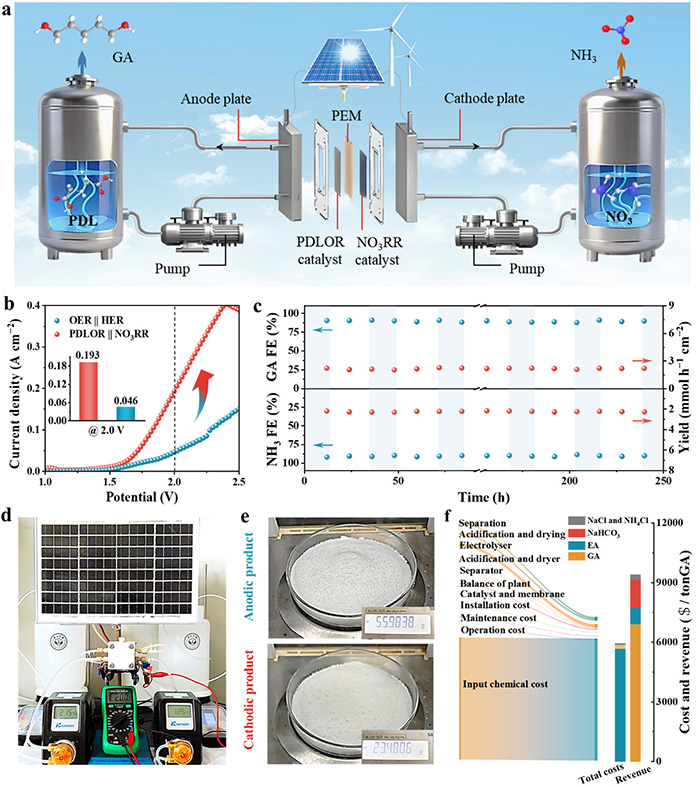
Continuous co-production of GA and NH3 in the pairing system. (a) Diagram of the flow reactor designed for simultaneous electrochemical co-electrolysis of NO3− and PDL in an integrated refinery process. (b) LSV curves of overall water splitting systems and PDLOR||NO3RR paired-electrolysis systems. (c) Durability measurement and the corresponding GA/NH3 yield and FE of the paired-electrolysis systems. (d) The physical diagram of the coupling device powered by solar panels. (e) NH4Cl and GA powders were obtained within 240 h. (f) TEA for the cost and revenue of the paired-electrolysis systems. ©Bin Liu et al.
| Title: | Modulating Ni-O-V Bridges in NiV-Layered Double Hydroxides Microspheres for Robust Electrocatalytic Coupling of 1,5-Pentanediol Oxidation and Nitrate Reduction |
|---|---|
| Authors: | Bin Liu, Hao Luo, Huiming Wen, Ke Li, Yuchen Wang, Yizhou Zhang, Hao Li, Kai Yan |
| Journal: | Angewandte Chemie International Edition |
| DOI: | 10.1002/anie.5292155 |
Hao Li (Profile of Dr. Li)
Advanced Institute for Materials Research (WPI-AIMR), Tohoku University
| E-mail: | li.hao.b8@tohoku.ac.jp |
|---|---|
| Webstie: | Hao Li Laboratory |