


Developing new materials can involve a dizzying amount of trial and error for different configurations and elements. It is no wonder that artificial Intelligence (AI) has seen a surge of popularity in energy materials research for its potential to streamline this time-consuming process. However, fully autonomous workflows that connect high-precision experimental knowledge to the discovery of credible new energy-related materials remain at an early stage.
A team of researchers at the WPI-Advanced Institute for Materials Research (WPI-AIMR), Tohoku University, created the Descriptive Interpretation of Visual Expression (DIVE) multi-agent workflow to streamline the material researching process. The system extracts information from images in a database of over 30,000 entries from >4,000 scientific publications to propose new materials within minutes.
The findings were published in Chemical Science on February 3, 2026.
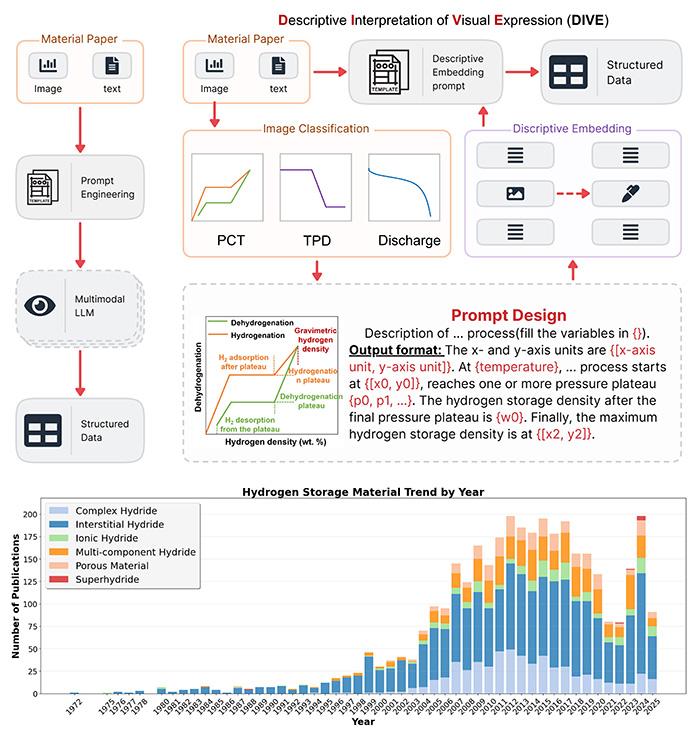
Comparison between DIVE’s multi-agent workflow and conventional methods, and the distribution of collected publications in the hydrogen storage materials database. ©Hao Li et al.
DIVE systematically organizes the information it pulls from existing literature regarding solid-state hydrogen storage materials. Its accuracy and coverage of data extraction was 10-15% better than commercial models, and over 30% better compared to open-source models. DIVE is easy to use, as input resembles a regular conversation. Simply provide DIVE with what criteria you are looking for, and it will draw from its database to propose suitable materials. It also demonstrates the ability to propose entirely novel materials that haven’t been reported in the literature before.
“DIVE can convert literature-embedded scientific knowledge into actionable innovation, offering a scalable pathway for accelerated discovery across chemistry and materials science,” says Distinguished Professor Hao Li (WPI-AIMR).
This research is significant because it builds a reliable, end-to-end pipeline that converts key experimental results otherwise hidden in paper figures into high-quality, machine-readable data, enabling faster and more accurate scientific synthesis and discovery. It reports clear performance gains over common extraction approaches and produces a large, curated hydrogen-storage database (DigHyd) built from thousands of papers, which can be directly queried and used to guide new material design. The Digital Hydrogen Platform (DigHyd) is the first digital platform for hydrogen storage materials design, and also the largest experimental and computational solid-state hydrogen storage database reported to date.
“The reason we want to know so much about hydrogen storage materials is because they are a key bottleneck for making hydrogen-based clean energy practical, safer, and more affordable,” explains Li. “Our proposed workflow with DIVE has the potential of accelerating evidence-based discovery, which means shorter turnaround times from when research is published to when it actually gets implemented in real-world technologies that help the environment.”
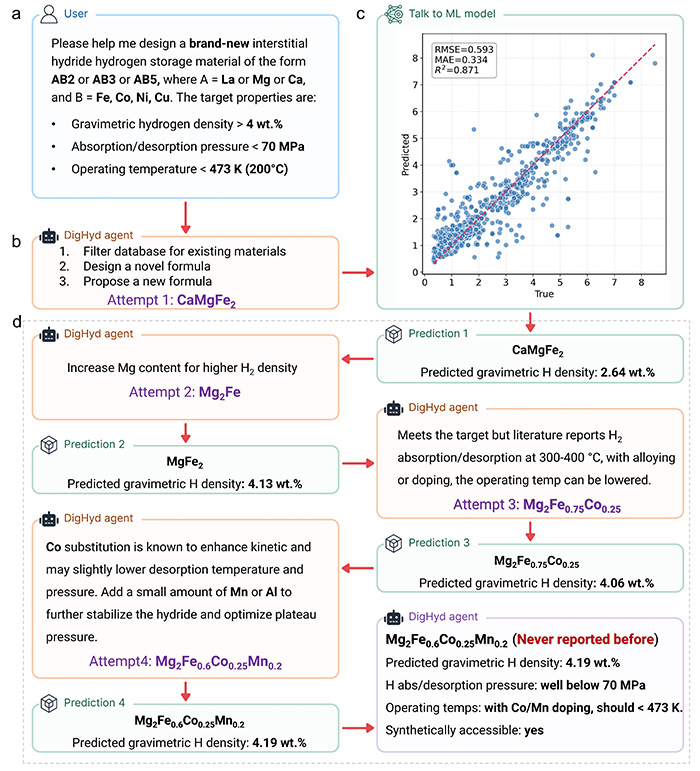
New materials design workflow powered by the AI agent platform ‘DigHyd.’ ©Hao Li et al.
| Title: | “DIVE” into Hydrogen Storage Materials Discovery with AI Agents |
|---|---|
| Authors: | Di Zhang, Xue Jia, Tran Ba Hung, Seong Hoon Jang, Linda Zhang, Ryuhei Sato, Yusuke Hashimoto, Toyoto Sato, Kiyoe Konno, Shin-ichi Orimo, Hao Li |
| Journal: | Chemical Science |
| DOI: | 10.1039/d5sc09921h |
Hao Li (Profile of Dr. Li)
Advanced Institute for Materials Research (WPI-AIMR), Tohoku University
| E-mail: | li.hao.b8@tohoku.ac.jp |
|---|---|
| Webstie: | Hao Li Laboratory |